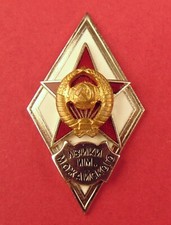
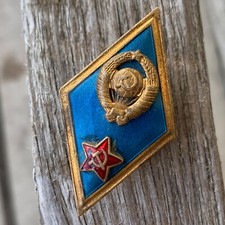
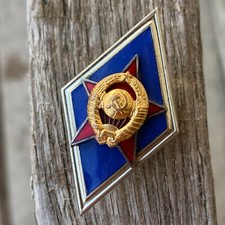
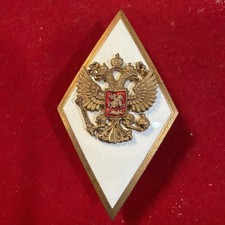
Volkspolizei Academy Graduation Badges
The Volkspolizei (German for "People's Police") was the national police of the German Democratic Republic (East Germany), whose officers were commonly nicknamed VoPos. Formed following the end of World War II and abolished after German reunification, Volkspolizei officers were trained like soldiers and were highly effective in enforcing the policies of the East German government.
The Volkspolizei was effectively founded just following World War II, when the Soviet Union established central police forces in the regions of Germany it occupied (in violation of the agreements at the Yalta Conference and the Potsdam Conference). The SVAG approved the arming of community-level police forces on October 31, 1945.
The name Volkspolizei began to be used in 1946. In August of that year, the Volkspolizei was placed under the control of the German Administration of the Interior. The first Volkspolizisten were mostly former Wehrmacht officers who had converted to communism, as well as former German members of the International Brigades in the Spanish Civil War.
It is not completely clear why the Soviet Union founded the Volkspolizei. The establishment of a force made up of Germans would imply that a sovereign German state would be on the way; however, Josef Stalin had no intention of pursuing this goal any further, at least in 1946.
It has been speculated that the Soviets attempted to mould East German society so as to be similar to the Soviet Union's. In the Soviet Union, uniformed troops assigned to tactical groups to combat counterrevolution were subordinate to the Ministry of the Interior, and the Volkspolizei was organised in the same fashion.
By November 1946, the Volkspolizei had more than 45,000 officers. In that same month the SVAG authorised the creation of the Border Police, 3,000 men who were charged with preventing mass emigration into West Germany. In December, the Transportpolizei was established.
Training centres:
University of the VP, Berlin-Biesdorf (Cecilienstrasse)
Technical school of the MdI "Heinrich Rau", Radebeul
Technical school of the MdI, "William Pieck" Aschersleben/Ballenstedt
Officer university "Bereitschaften" "Artur Becker", Dresden (Neuländer Str. 60)
Humboldt university to Berlin/section Kriminalistik
The earlier versions of the "Karl Liebknecht" and "Artur Becker" Academy badges ( 1977-1987) were higher quality with enamel. From 1987 to 1990 they were lacquered with the clearcover plastic coating.
The later, Civilian Highschool badge (1985-1990) is only found as a lacquered version.
Below are the three VOPO Academy badges, from left to right:
Civilian Highschool
"Artur Becker" Academy.
"Karl Liebknecht" Academy
Eddie
Everybody's equal, But some more than others!
"Those who come to us with the sword - will be killed by the sword" - Alexander Nevski
"Those who come to us with the sword - will be killed by the sword" - Alexander Nevski