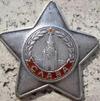
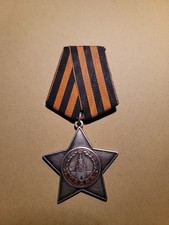
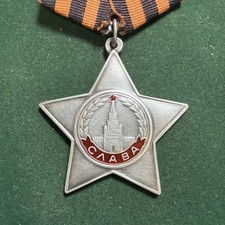
Here's a cool award I am glad to share with you guys--and my first Japanese conflict award. :thumbsup Military historian David Glantz calls operation August Storm "massive, relentless, spectacular."
The awardee saw action for the period of less than one month that this conflict lasted. His 190 Rifle Division was part of the 5th Army, which shot Westward from Vladivostok and participated in mountainous battles for Mudanjiang and Harbin. Unfortunately there is no exact location noted on the citation--some day I'll try getting the military map of the area to figure out the referenced height. This Glory-III and VOJ medal were the awardee's only awards.
Thanks for reading!
George
Award Citation
1. Last name, name and patronymic : Katasonov Vasily Tihonovich
2. Rank : Sergeant
3. Duty: Commander, Rifle Detachment 58 Rifle Regiment, 190 Rifle Division
Recommended for: Order of Glory III Class
4. Birth year: 1914 Kuybyshevskaya Oblast Davydovsky District Badeevsky Selsoviet
5. Nationality: Russian
6. Party Membership: none
7. Participation in civil war, subsequent combat operations at the defense of the USSR in patriotic war: participant in combat with japanese invaders since 9.8.1945 1st Fareastern Front
8. Wounds or contusions in patriotic war: none
9. In Red Army: Since March 1942
10. Inducted by: Molotovsky DMC, Kuybyshevsk Oblast
11. Previous Awards: none
12. Permanent address of recommended for award and family address: Kuybyshevskaya Oblast Davydovsky District Badeevsky Selsoviet Father Katasonov Tihon Egorovich
I. Short, concrete description of personal combat feat or accomplishment:
In 1945 during the period of company's advancement, [Katasonov] bypassed the opponent from the flank and rushed with his detachment into the enemy's trench at the height 471,5. With his assault rifle at point blank range he shot 5 japanese kamikazes. From the flank, a japanese machine gun opened fire at Katasonov's detachment, another machine gun opened fire from the other side. Katasonov was thus caught in cross fire. [Katasonov] split the detachment in two groups--destroyed one machine gun but the second one continued to fire. Only two men remained in the detachment. With his remaining men, Katasonov crawled to the japanese machine gun and destroyed it and its personnel with grenades. [Katasonov] personally destroyed 10 japanese soldiers and officers, provided for forward advancement of the company and for carrying out set objective.
For valor, courage, and bravery demonstrated in struggle with japanese invaders recommend for awarding with government award order of Glory III Class.
Commander of 58 Rifle Regiment Podpolkovnik Mitrofanov.
13 September 1945
By order of 10 Rifle Division from 28 September 1945
awarded the order of Glory III Class
chief of staff of 10 Rifle Division
First Lieutenant Zaharov