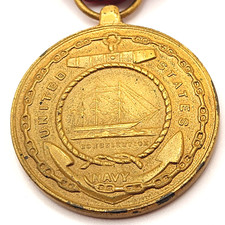
Gents, what do you think?
I'm leaning towards 'OK', in my very limited experience. Looks to be well-struck and I see no obvious warning signs.
Opinions?:confused:
"patina imparts character" - PJS
A wise man said: 'you should not pay a premium for what you want beyond your comfort level, and always ensure there is a mutually agreeable return policy.'
No. I see what you mean. I've just done a google search and have found many different variations; all fairly slight. And even then who knows if the images are from legit medals.
Thanks, Marc.
"patina imparts character" - PJS
A wise man said: 'you should not pay a premium for what you want beyond your comfort level, and always ensure there is a mutually agreeable return policy.'
Here is a rather obscure item pertaining to a rather overlooked period of history.
An English translation (of which purpose we can only speculate, such as to be presented as evidence in the multi-national project) of a 1912 awarding of the Medal "For Zeal" on the Saint Stanislaus Ribbon.
CHINESE EASTERN RAILWAY COMPANY.
CHANCERY
17th January, 1912.
CERTIFICATE
The bearer of the present Mr. P. I. Tarnavsky was employed in 1910 as a fireman with the Plaque Prevention Service in the Chinese Eastern Railway Zone, and on September 28th 1911 has been MOST GRACIOUSLY rewarded for his work with a silver MEDAL attached to a STANISLAUS BADGE and bearing the inscription "FOR ZEAL", - in witness whereof was hereunto set our hands and official seal.
Signed /Pince Hilkoff/
For General Manager of the RLY.
Signed /Brotonovsky/
Managers of Affairs.
Research reveals that there was only a single train, with a single locomotive, with a single fireman on that expedition.
Researching this Plague Prevention Service exhibition a bit over the last year I've found two photographs of the Railway workers during the time period Tarnavskij was in service.
I would suggest the most probable candidate to speculate as being Tarnavsky is the chap top right in the second picture, up against the locomotive.
I also found the full (illustrated) report of the expedition that was published in 1913. Although almost forgotten today this was the last major outbreak of the "black death" and was still infecting the Soviet Union's eastern areas until the 1920's.
On the morning of May 26th, 1911, I arrived at Manchouli to make enquiries as to the conditions under which hunting took place, and to gather information which would prove useful in making arrangements for an expedition into the Tarbagan country later in the year. My observations made at that time are embodied in this Report. I left Manchouli on the evening of May 29th and returned to Harbin. About this time of the year large numbers of coolies arrive in Harbin principally from the province of Shantung to find work in the north. Most of them obtain employment along the Sungari and Amur rivers. On May 30th I saw a train reach Harbin station with over 1000 coolies; like others from Shantung, they possessed a fine physique and were in the best of health. Soon afterwards official business took me to Peking.
In the beginning of July rumours were afloat that a large number of Tarbagans were dying in the neighbourhood of Scharasone (Transbaikalia, Siberia). On July 11th I left Tientsin with orders to organise an expedition to investigate the matter, as the Chinese Government were most anxious that all measures should be taken to forestall a possible spread of Plague to man. The Manchurian authorities agreed to build hospitals for Plague at all the important centres and instructed me to staff them with properly qualified medical officers; and from the Viceroy at Mukden downwards, all the officials took great interest in the proposed expedition. I quote the following from the Peking Daily News:
Tarbagan Epidemic in Siberia spreading southwards. (Special Dispatch to the P.D.N.)
HARBIN, July 13th.
" My correspondent at Station Manchouli wires that the Tarbagan epidemic of Siberia is spreading southwards towards the Chinese frontier. Dead marmots are now found as far south as Scharasone which is only thirty-five miles north of the Russian-Chinese frontier. Local measures are sufficiently strict to prevent the disease from entering Manchuria. Some members of the Chinese Scientific Expedition for the study of Tarbagan diseases have already arrived here."
Arriving at Harbin on July 15th, I called on Professor Zabolotny, who was at that time working at certain plague problems in the Russian Laboratory of that town. After showing me his specimens and telling me the results of his investigations-a note of which appears in this Report -he invited me and my party to proceed with him to Manchouli in a special car provided by the Chinese Eastern (Russian) Railway I gladly availed myself of the invitation. It is interesting to note that this was the first scientific expedition sent out by the Chinese Government.