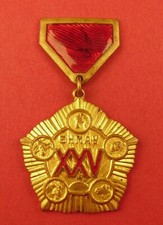
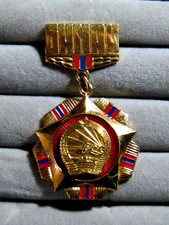
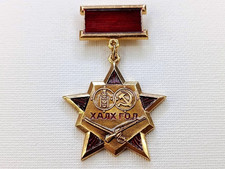
Social changes documented in the three constitutions of the country during 1924, 1940 and 1960, had a great impact on the manufacture of awards.
The name of the country, the official flag, the seal and the alphabet changed several times.
For example, the Cyrillic alphabet was used from 1941 to 1992. These factors may be used to determine the time frame during which the awards were produced and distributed.
There are three basic types of the seals. The first type has three variations, the second type has two, and the third type only has one. Many of these symbols coexisted during certain times. They are:
1. the old Mongolian symbol Soyombo
1.1 the plain symbol - 1924 - 1939
1.2 the plain symbol with laurel branches - 1939 - 1945
1.3 the plain symbol with a star at the top (a sign of victory over Japan) - 1945 - 1992
2. the seal with animals as a heraldic figures
2.1 with a Mongolian inscription on a red ribbon - 1940 - 1955
2.2 with a Cyrillic inscription on a red ribbon - 1955 - 1960
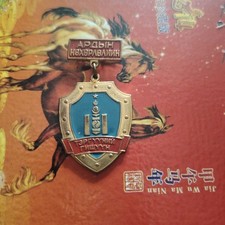
3 the seal with a mechanical gear and a red - blue - red ribbon - 1960 - 1992
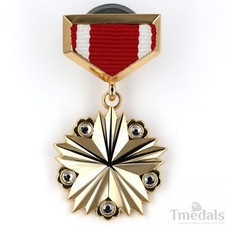
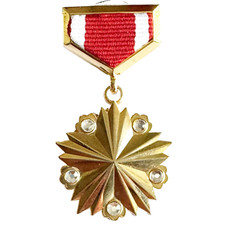
Many awards have the imprint BNMAU wich stands for the Mongolian People's Republic. In summary, relatively few orders and medals were produced and distributed in this country , due to the small size of its population. There are fewer awards given than in similarly sized countries. There are some rare pieces among the early orders and medals, wich are virtually unavailable. A good example of which is the cosmonaut's medal.
Because of political, economic and military constraints, the distribution of Mongolian awards outside of Mongolia went primarily to citizens of the Soviet Union.
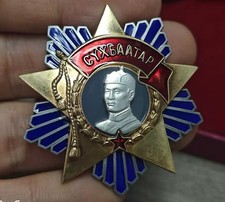
The Suche Bator order, the highest award in the country, was awarded to foreign dignitaries of socialist states in relatively large numbers.
Everybody's equal, But some more than others!
"Those who come to us with the sword - will be killed by the sword" - Alexander Nevski
"Those who come to us with the sword - will be killed by the sword" - Alexander Nevski