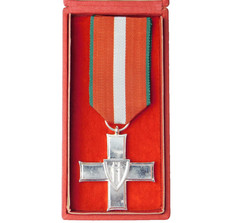
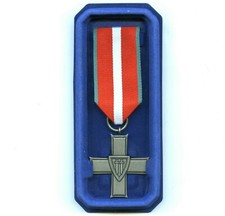
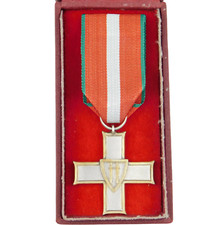
(Order Krzyza Grunwaldu)
This Order was instituted on November 8th, 1943 (executive January 1, 1944) as an award of Gwardia Ludowa (People's Guard) - a leftist Resistance organization; confirmed by the new Polish authorities on February 20th, 1944. On December 23rd, 1944 included in the new award system by a decree of Polski Komitet Wyzwolenia Narodowego (Polish Committee of National Liberation.
The order's name and symbols go back to a victorious battle with the Teutonic Order, held at Grunwald (Tannenberg) on July 15, 1410.
Grunwald is a village in northern Poland, 30 km south from Olzstyn. Here one of the most important European battles of the Middle Ages was fought.
Two allied forces both Polish and Lithuanian of about 50 000 men led by the Polish king Vladislav and the Lithuanian prince Vitold fought against The Order of German Knights of about 40 000 men which was led by its Grand master Ulrich von Juningen.
The battle ended up by crushing defeat of the Order of German Knights and the beginning of the end of the Order.
There are two stories about the swords dipicted on the Order.
One says that the German Knights sent a horseman with a blunt sword to the Polish and Lithuanian forces as a challenge. When he returned there was a sharp sword tied to it meaning that they accept the challenge. The other states that the battle was initiated by Juningen as he sent two of his knights with drawn swords and a message, that said, the knights should help the Polish fight because the Polish did not dare to start fighting.
Vladislav accepted the challenge and he commanded to start the fight.
The order was conferred in three classes, at first in a provisional form of the ribbon bar, replaced by the cross at the beginning of 1945. The order was meant primarily for soldiers of communist and leftist military organizations in opposition to the Home Army.
The 1st class of the order was conferred for outstanding merit in armed forces' organization and commanding big military operations.
2nd class - for commanding military units and organizing the armed forces.
3rd class - for acts of personal bravery or active underground work.
The order could be awarded once in each class. In Peoples' Poland the order was conferred for merit in organizing and commanding the armed forces. It was discontinued in 1992.
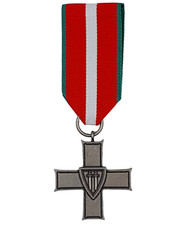
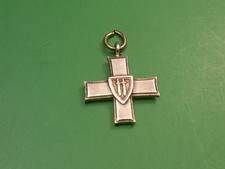
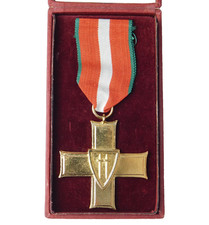
1st class: non-enameled Greek cross of gold, with lowered edges, 55 x 55 mm. In the middle there is a gothic shield bearing two swords pointed down - a symbol of the battle of Grünwald.
The reverse of the shield bears the inscription: 1410 / K.G. / 1944. Until 1952 the badge was worn from a cravat; since then it has been worn from a breast ribbon, just like the other two classes.
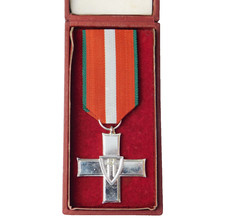
2nd class: as above, but in silver and in the dimensions 44 x 44 mm; with gilt swords and the shield's and the cross' edge. III class: as above, but entirely in silver; the cross' edge on the reverse is not lowered.
Ribbon: 35 mm, red with a wide white central stripe and green edges.
Eddie.
Order of the Cross of Grunwald 3rd Class with issue box.
Everybody's equal, But some more than others!
"Those who come to us with the sword - will be killed by the sword" - Alexander Nevski
"Those who come to us with the sword - will be killed by the sword" - Alexander Nevski