(To be filled out using a typewriter, without corrections)
(Date and location of issue of the award; republic, krai, oblast, city, raion)
1. Last name: Bocharatsvili
2. First name and patronymic: Boris Melkovich
3. Nationality:
4. Sex:
5. Year of birth: 1923
6. Place of birth:
7. Education: higher, unfinished higher, special secondary, secondary, elementary (underline what’s relevant)
8. Party affiliation:
9. Duty position, profession, military rank (for servicemen), place of work or service at the time of the award (ministry, department, institution, enterprise, organization): Senior Sergeant, mechanic-driver of a T-34 tank in the 1st Tank Battalion of the 39th Tank Brigade
10. Home address of the awardee: City of Tkvibul, Georgian SSR
11. Awards issued:
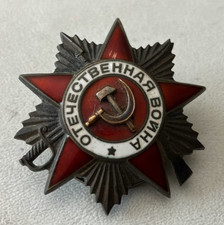
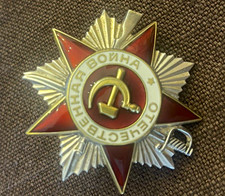
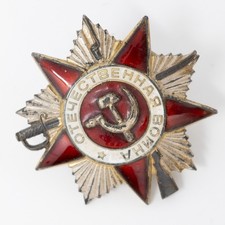
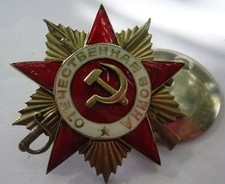
Order of the Patriotic War, 2nd Class 102116 Temporary certificate nr. B-391313 Order of the 23rd Tank Corps nr. 05/N of April 21, 1944
Signature of the awardee:
I confirm the correctness of the data and the signature of the awardee (duty position, signature):
Last name, first name and patronymic, military rank and date of issue of the order or medal: Bocharoshvili, Boris Melkovich;Senior Sergeant; June 7, 1944
Number of the order or medal: 102116
Number of the temporary certificate: A-391313
Awarded by: Tank corps
Order or decree number and date: 05/N of April 29, 1944
1. Last name, first name and patronymic: Bocharoshvili, Boris Melkovich
2. Rank: Senior Sergeant
3. Duty position and unit: Mechanic-driver of a T-34 tank in the 1st Tank Battalion of the 39th Chaplinka Red Banner Tank Brigade
Nominated for: Order of the Patriotic War, 2nd Class
4. Year of birth: 1921
5. Nationality: Georgian
6. Party affiliation: Member of the Komsomol since 1942
7. Participation in the Civil War, the following combat actions for the defense of the USSR and the Patriotic War: Has been participating in the Patriotic War since 1941
8. Since when in the Red Army: Since June 10, 1940
9. Drafted by which military commissariat: Military Commissariat of the city of Tkvibuli, Georgian ASSR
10. Wounds and contusions received during the Patriotic War: On August 20, 1941 with the Western Front
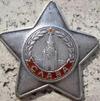
11. Which earlier awards (for which merits): Order of the Red Star by Order of the 63rd Rifle Division nr. 8/N of December 9, 1942
12. Permanent home address of the prospective awardee and the address of his family: _______________
Short, concrete description of the personal combat feat or merits:
During the fighting with the German invaders comrade Bocharoshvili displayed courage and bravery.
On April 1, 1944, near the village of Antonovka, he attacked three times. He boldly forced his way to the enemy positions, where he used his tank’s tracks to kill enemy troops and destroy materiel.
He destroyed 1 anti-tank rifle, 2 machine guns, 1 mortar and its crew and over 30 German soldiers and officers.
He deserves the Order of the Patriotic War, 2nd Class.
Commander of the 1st Tank Battalion of the 39th Chaplinka Red Banner Tank Brigade
Major [signed] /Gaponenko/
He deserves the Order of the Patriotic War, 2nd Class.
Commander of the 39th Chaplinka Red Banner Tank Brigade
Colonel [signed] /Lyskin/
April 22, 1944
He is to be awarded the Order of the Patriotic War, 2nd Class.
Commander of the 23rd Tank Corps
Guards Major General of Tank Troops [signed] /Akhmanov/
April 26, 1944
I have a similar citation to a man in Stalingrad and he was awarded a Medal "For Bravery". Is there any connection to the USSR's level of success to the level of award they handed out?
Of course it goes without saying - Yet another fabulous award under your belt!
This question is really interesting. I think sometimes we are all surprised by reading citations, downgradings / upgradings recommendations, as well as stories of similar feat which was however "rewarded" in very different ways.
First, we all know that decorations were awarded with more "sparingly" at the beginning of the GPW, and more "generously" to the end.
Then, for the OPW or OG, for example, statutes identified certain achievements that deserve to be rewarded. Such as, for OPWII: Who is with his tank destroy at least three enemy gun emplacements, and so contributed to the advancement of our advancing infantry;
Who, being in a tank crew, has successfully completed three tasks of combat to destroy enemy personnel or destroy in combat at least 3 of enemy tanks or three guns. .. etc
But the most important factor - and we can perceive this, when we read the memoirs of frontoviks - the difference is mainly due to the attitude of command.
A good example is found in A.V. Pyl'cyn Penalty Strike: The Memoirs of Red Army Penal Company Commander, (Stackpole, 2006, p. 27)
"Our battalion commander , Osipov, personnaly recommend officers for decorations ... based on their merits, regardless of how high his own personnal decoration would be. In matter of distributig decorations, a lot, if not all, depend of the commanders.....
Baturin ... who replaced .. Osipov ... was very greedy for decorations, and very unwillingly decorated company commanders and platoon leaders. He was always first, in waiting for his own decoration. He did not want anyone for a decoration higher than his!"
And then I suppose also, that there were "social", "ethnic", "personal" considerations that should be taken into account. Also the "traditions" of some units.
Not to mention the fact that a few lines of description of an exploit will never say the actual circumstances of a feat of arms.
I know exactly what you mean with the descriptive citation. I have a Medal "For Bravery" which basically says "For being business like" although it was to a private... Sometimes you really have to read between the lines i.e. he kept his mouth shut. Other times you get a simple 1 line citation and reading between the lines is reading too far.
There is so much joy, knowledge and confusion to be found in these citations.