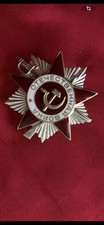
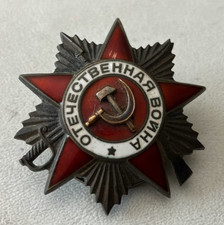
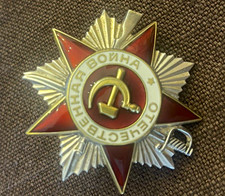
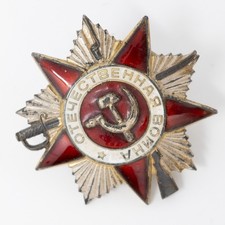
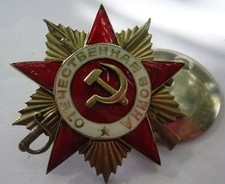
The gold content for the Gold/Copper alloy used for all types and variations of the Order of the Patriotic War (I'm not sure of the purity of the plating on the 1985 jubilee award) is 583/1000 pure. That is the content for the plating and for the solid hammer and sickle. Rusty is correct, Gold will not oxidize which is why there is not much fluctuation in color for an award with a much higher Gold content, such as the Gold Star for a Hero of the Soviet Union, which is solid gold, 950/1000 pure.
Then does the Order of the Patriotic War 1st class (not the 85’ issue) body have a similar gold composition to the hammer and sickle? Or does the body have higher Au content. I know that the 1st Class Order of the Patriotic War contains 8.329g +/- 0.38g Au, 14.482g +/-1.02g Ag and 0.0g Pt. -- Now you got me very interested in the metallurgy of Soviet orders.
If you are referring to the starburst - It's made of 14K gold.
I believe it's made of 583 Gold (Russian Standard Mark) which is 14K.
This may benefit some members...
Gold is yellow and copper is red, the only two coloured pure metals. All other metals are white or grey in colour. The addition of a red colour to yellow, as every school child knows, makes the yellow pinker and eventually red. The addition of a white makes the yellow colour paler and eventually white. This principle of mixing colours is the same in carat golds. Adding copper to gold makes it redder and adding silver, zinc and any other metal makes gold paler. Thus, we can understand that lower carat golds, because we can add more alloying metals, can have a wider range of colours than the higher carat golds.
Thus at 22 carat (91.6% gold), we can only add a maximum of 8.4% of alloying metals and hence can only obtain yellow to pink/rose shades. At 18 carat (75.0% gold) and lower, we can add 25% or more alloying metals and hence get colours ranging from green through yellow to red, depending on the copper: silver plus zinc ratio. Thus at any given caratage we can vary the colour by varying the copper: silver plus zinc ratio. This can be demonstrated in the following table:
Gold is usually described in terms of caratage (karatage), which is an indication of its gold content, for example 18 carat or 18K. Alternatively, the gold content can be described in terms of 'fineness' which is the gold content expressed in parts per thousand.
Pure gold ('fine gold') is 24 carats (karats) and so 24 carats is theoretically 100% gold. In Chinese, it is also known as "Chuk Kam", meaning 'pure gold' and is defined as 99.0% gold minimum. Thus, there is a 1.0% negative tolerance allowed in this case.
The Caratage System
Any caratage value lower than 24 is a measure of how much gold there is in the gold alloy. Thus 18 ct is 18/24ths of 100% gold = 75.0% gold. In fineness terms, this is described as 750 fineness, i.e. 750 parts of gold per thousand parts. The table below gives the various caratages and their equivalent gold content in percent or in fineness terms as recognised by international standards. This is not always exactly the mathematical value! For example, 22 carat is mathematically 22/24ths x 100 = 91.666% but the accepted international standard is 91.60%
Definition of Caratage in gold content for recognised
international standards:
"Be civil to all, sociable to many, familiar with few, friend to one, enemy to none." Benjamin Franklin
-------------------------------------------------------------------------------------------------------
Member #193
Wow! I am sure that many others will benefit from these charts. I put the alloy table in my notes. Big thanks – you are my friend!
;)
And thanks for the info on the starburst -
AC
"The friendship of the peoples of Germany and the Soviet Union, cemented by blood, has every reason to be lasting and firm."
- Josef Stalin, (Christmas greeting to Hitler, 1939)
I would like to get your opinions on the attached OGPW2 Type 2. This is an unusual (to say the least) piece which does not fit any category previously compiled for OGPW2 Type 2.
It is neither "Starback", nor "Concave". Nor is it a "Ring Reverse", however it does exhibit some elements of Concave/Ring Reverse Types.
Please let me know what you think.
I did seek Alex F's opinion about this, and he has come up with a conclusion that this may be a duplicate order from Krasnokamsk Monetny Dvor (KMD), however this one was issued before there existed a cyrillic "Ä" on the reverse.
-Eric
Soviet Union is the only country with an unpredictable ... past!