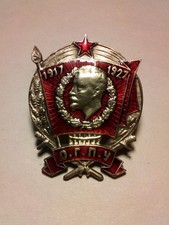
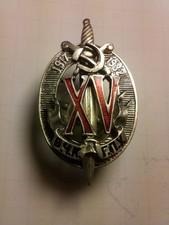
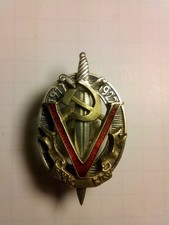
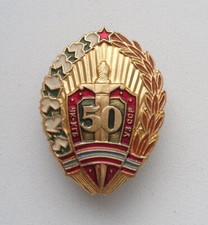
The NKVD, or Narodnyi Komissariat Vnutrennikh Del - People's Commisariat for Interior Affairs, was the name for the political police in the USSR in one of the stages of its development.
The NKVD was created in early 1918 to handle policing and internal affairs. However, it did not obtain state security functions until it took over the OGPU in July 1934. State security functions were then handled by the NKVD's GUGB ("Glavnoe Upravlenie Gosudarstvennoi Bezopasnosti" or Main Directorate of State Security). On 8 February 1941, the Special Sections of the NKVD (responsible for counter-intelligence in the military) were given to the Army and Navy (NKO and NKVMF) where they became the SMERSH (from Smert' Shpionam or "Death to Spies"). In April 1943, GUGB was removed from NKVD and renamed NKGB.
During World War II, NKVD units were used for rear area security, including halting deserters. On "liberated" territory the NKVD and NKGB carried out mass arrest and deportations, at times forcibly resettling entire populations (650,000+ Crimean Tatars, Chechens, Ingush, and others) or significant parts (Lithuanians, Poles) to Central Asia and Siberia.
--------------------------------------------------------------------------
In 1934 the powerful OGPU was restructured and became part of the newly created NKVD(Narodnyi Komissariat Vnutrennykh Del (The People's Commissariat of Internal Affairs) and thus this entity gave birth to the "Great Terror" (1936-1939) where 1.000.000 people were killed, even entire innocent families and where 2.000.000 people were sent to forced labour camps to end their days.
The arrival of the NKVD in Soviet society meant that anyone deemed a danger to the State could be ordered to be imprisoned and resettled without the benefit to be heard. The NKVD was in control of the: militia, frontier control, all armed forces which were not directly part of the armed forces, force labour camps, prisons and all fire brigades. The power that the NKVD had at its disposal allowed Stalin to use this organism against the party and the country and this led to the Great Terror of the 1930's; one can only imagine and shudder at the thought of living in such an opressive manner, between 1934 and 1938 millions were arrested and ended their lives in forced labour camps. On April 17, 1935 Stalin issued the death penalty for children as young as twelve years of age, and thus furthering plummeting his mind into madness.
In 1936 the head of the NKVD, Genrikh Yagoda, was replaced because Stalin had accused him of not showing enough zeal for his work; Stalin by this time was very paranoid and rationalized that if you did not show zeal for your duties that meant your thoughts were problably somewhere else planning the downfall of the Soviet Union. Yagoda was a cruel man and his specialty was murdering by poison he was a cold hearted killer who did not have to be questioned for his loyalty and fondess to cruelty and death, Agabekov described Yagoda as:"brutal, uncultivated and gross". Yagoda died in a jail cell at the Lubyanka Prison (but not after being a witness to Stalin's death, as Stalin was dying, he had another stroke, Yagoda said of him: "Dead Meat". (The current thought is that Yagoda had Stalin poisened but that has not been proven as of yet). But recent documents shift the blame to Beria for when Stalin was found unconscious, unable to talk and having wet his pants Beria simply said: "Master is having a sound sleep. Don't get scared and don't bother us." Master was dying of a stroke and noone can prove that it was a natural one or if it was a stroke that finally put an end to this tyrant. Stalin felt secure in his next appointment for the NKVD. Yeszhov was appointed as the head of the evil NKVD and a new reign of terror began that even surpassed, somehow, the cruelties of the past. This reign was savage and irrational, perhaps the very enbodyment of Stalin's derranged mind. The story of Yagoda does not end with him in a jail cell "thinking" about his unloyalty to Stalin and lamenting his leaders death. In March of 1938, Yagoda and 21 other "Anti-Soviets" were found guilty and sentenced to death, most blamed Yagoda for Stalin's death and perhaps Yagoda was being punished for it.
Everybody's equal, But some more than others!
"Those who come to us with the sword - will be killed by the sword" - Alexander Nevski
"Those who come to us with the sword - will be killed by the sword" - Alexander Nevski