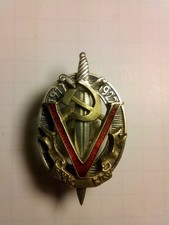
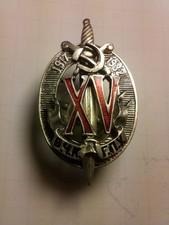
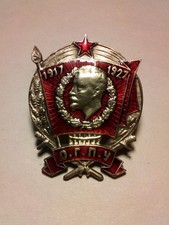
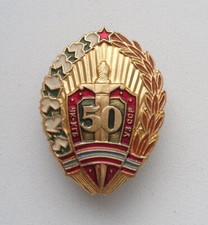
The KOMITET GOSUDARSTVENNOY BEZOPASNOSTI, KGB, was created in 1954 following the ousting of Beria, it adopted the Cheka emblems of the shield and the sword: the shield to defend the Revolution and the sword to smite its foes.
Committee for State Security, was the name of the main Soviet external security and intelligence agency, as well as the main secret police agency from March 13, 1954 to November 6, 1991. The KGB's domain was roughly that of the American CIA and the counterintelligence division of the FBI.
Ivan Serov was the leader of this newly created terror machine whose immidiate task was to purge the Beria supporters, the cruelty shown by the KGB alarmed the Soviet citizens. Ivan Serov remained in power for four years and was replaced in 1958 by Alexander Shelepin who ran the service until November of 1961, when he was replaced by Vladimir Semichastny who served until 1967.
Yury Andropov headed the KGB for 15 years from 1967 to 1982. Andropov favored the savage approach favoured by during Stalin's era and did not seem to care about the 62,000,000 people that perished at the hands of the Soviet secret service, the KGB was in charge to maintain heavy surveillance of intellectual and dissidents right up to the end of the Soviet Union. The KGB was not content to just remain docile with its satellite nations, it wanted to expand into Latin America wihtout having the electoral route as an option(it never did) but it rather seeked the to remain in the shadows and instigate those who are not politically educated. The Russian secret policy is trying to put severe limitations on internet users in Russia, the cybernaughts in that country are being subjected to having any e-mail messages read and any webb-page created or sent to one of the internet users in Russia severely scrutinized for content, this is being done by the former KGB which is now named FSB.
The KGB was dissolved due to the participation of its chief, Colonel General Vladimir Kryuchkov, in the August 1991 coup attempt designed to overthrow Mikhail Gorbachev. He used many of the KGB's resources to aid the coup attempt. Kryuchkov was arrested, and General Vadim Bakatin was appointed Chairman on August 23, 1991 with a mandate to dismantle the KGB. On November 6, 1991 the Russian KGB officially ceased to exist, though its successor organization, the Federalnaya Sluzhba Bezopasnosti, or FSB, is functionally extremely similar to the KGB. Belarus is the only post-Soviet society where the successor organization continues to be called the KGB. Belarus is also where one of the founders of the KGB, Felix Dzerzhinsky — who was born in a town now within Belarusian territory — remains a national hero.
Some members of the KGB refered to it as "The committee" while other employees called it the Kontora Grubhyk Bandytov, that is, the "association of crude bandits".
Everybody's equal, But some more than others!
"Those who come to us with the sword - will be killed by the sword" - Alexander Nevski
Its tasks were external espionage, counter-espionage, liquidation of anti-Soviet and counter-revolutionary formations within the USSR, and guarding the leaders of the party and state. Unlike Western intelligence agancies, the KGB was (theoretically) not interested in learning enemy intentions, only their capabilities. Intentions were political decisions based on Marxist theory and the personal whims of the leadership.
In its espionage role, the KGB was mostly reliant on human intelligence, unlike their western counterparts, who relied far more on imagery intelligence (IMINT) and signals intelligence. Using ideological attraction, the Soviets were successful in recruiting a number of high level spies. Most notable are the KGB successes in gathering US atomic secrets, and the Cambridge Five, especially Kim Philby in the UK. This ideological method of conversion failed after the 1956 crushing of the Hungarian uprising. Instead, the KGB was forced to rely on blackmail and bribery for most of its defectors. This still achieved notable succeses, such as CIA mole Aldrich Ames and FBI mole Robert Hanssen, but far fewer than earlier.
Everybody's equal, But some more than others!
"Those who come to us with the sword - will be killed by the sword" - Alexander Nevski
04-10-2004, 10:55 PM (This post was last modified: 04-12-2004, 10:59 PM by Taz.)
Alger Hiss is alleged to have been a KGB spy, but there is no hard evidence.
Robert Hanssen provided the KGB with information on U.S. counterintelligence efforts through his job at the FBI.
Aldrich Ames was a KGB mole within the CIA.
Ethel and Julius Rosenberg were executed by the United States for providing information on the US's atomic programs to the KGB.
James Jesus Angleton, head of CIA counter-intelligence, reportedly lived in deathly fear that the KGB had moles in two key places: CIA counter-intelligence and FBI counter-intelligence. With those two moles in place, the KGB would have control or awareness of all U.S. efforts to catch KGB spies, and could protect their assets by safely redirecting any investigation that came close, or at least provide sufficient warning; also, counter-intelligence had the job of vetting foreign sources of intelligence, so moles in that area were in a position to give a stamp of approval to double agents against the CIA. With the capture of Aldrich Ames and Robert Hanssen, it appears that Angleton's fears, deemed paranoid at the time, were well-grounded.
The KGB occasionally conducted assassinations, mainly of defectors
Everybody's equal, But some more than others!
"Those who come to us with the sword - will be killed by the sword" - Alexander Nevski
The KGB was organized into directorates. Some of the main directorates were:
The First Chief Directorate (Foreign Operations) was responsible for foreign operations and intelligence-gathering activities.
The Second Chief Directorate was responsible for internal political control of citizens and foreigners within the Soviet Union.
The Third Chief Directorate (Armed Forces) controlled military counterintelligence and political surveillance of the armed forces.
The Fourth Chief Directorate - ?
The Fifth Chief Directorate also dealt with internal security. Originally created to combat political dissent, it took up some of the tasks previously handled by the Second Chief Directorate.
The Sixth Chief Directorate - ?
The Seventh Directorate (Surveillance) handled surveillance, providing equipment to follow and monitor the activities of both foreigners and Soviet citizens.
The Eighth Chief Directorate was responsible for communications. It dealt with monitoring foreign communications and was also responsible for the cryptological systems used by KGB divisions, transmission to KGB stations overseas, and the development of communication equipment.
The Ninth Directorate (Guards Directorate) provided guards for principal Party leaders and their families, and major government facilities in the Soviet Union.
Everybody's equal, But some more than others!
"Those who come to us with the sword - will be killed by the sword" - Alexander Nevski
born on August, 13 1905. in Afimskoe village of the Vologda province to a peasant family.
Member of the VKP since 1926.
1939 - ended Frunze Military Academy
February, 1939 - In the Ministry of Internal Affairs.
1939-1941 - national commissioner vnutrenih USSR.
1941-1945 - first assistant narkoma (minister) of a state security, then the assistant narkoma internal affairs of the USSR.
1947-1953 - first deputy minister of internal affairs of the USSR.
March 1954 till December 1958 - chairman of KGB of the USSR. with the rank of General.
He entered the NKVD in 1939 and as a deputy in the State security he was responsible for the Beriya deportations.
Serov commanded the deportation of German rocket and atomic scientists into Russia in 1945. He replaced the ill Kruglov in 1954 with strong support from Malenkovski.
Serov was an experienced analyst and a chekist. But when he saw the inability of the chekists to work properly in the West, he sought help by the STASI's Markus Wolf. He was able to place agents in the NATO staff. Serov tried to improve the education of KGB workmen, so his dismissal in 1958 was a big surprise. This might have been Khrushchev's reaction to the Hungarian revolt and Serov's failure in disclosing a would-be revolt against Khrushchev.
He died in 1990.
Everybody's equal, But some more than others!
"Those who come to us with the sword - will be killed by the sword" - Alexander Nevski
Was born on August, 18th 1918. in Voronezh.
1939 - Komsomol worker.
Member of the VKP since 1940.
1952-1958 - from December, 25th 1958 1st secretary of Central Committee VLKSM.
November, 14 1961. - chairman of KGB of the USSR.
Died in 1994.
Everybody's equal, But some more than others!
"Those who come to us with the sword - will be killed by the sword" - Alexander Nevski
Was born on January, 15th 1924. in Grigorevka village near Mezhevskogo, Dnepropetrovsk area.
Early1941 - Labour activitys.
In 1941 - 1942 - student of the Dnepropetrovsk himiko-institute of technology. For many years was on Komsomol and party work.
Member VKP since 1944.
1961 - 1967 - chairman of KGB of the USSR.
With the rank of general-colonel.
He died in 2001.
Everybody's equal, But some more than others!
"Those who come to us with the sword - will be killed by the sword" - Alexander Nevski
Born on June 2nd or June 15th, 1914 - Died February 9th, 1984
He was a Soviet politician and General Secretary of the CPSU from November 12, 1982 to February 9, 1984.
1936 - Komsomol and party work. Finished the Maximum party school at the Central Committee of the CPSU.
1939 - Member VKP.
1953г - diplomatic work.
1954-1957 - the ambassador of the USSR in VNR.
1957 - Head of a department of the Central Committee of the CPSU, simultaneously in 1962 - Secretary of the Central Committee of the CPSU.
1967-1982 - Chairman of KGB of the USSR with the rank of general.
May 1982 - Secretary, and since November 1982 - the Secretary general of the Central Committee of the CPSU.
1983 - Secretary general of the Central Committee of the CPSU. and simultaneously Chairman of Presidium of the Supreme Soviet of the USSR. died in 1984. He is buried in the Red square, Moscow.
His place of birth and parentage is uncertain, but he was probably born in Nagutskoye near Stavropol in southern Russia. He was briefly educated at the Rybinsk Water Transport Technical College before he joined Komsomol in 1930. He graduated to the full party in 1939 and was first secretary of the Komsomol in the Karelo-Finnish Republic from 1940 to 1944. After the war, he moved to Moscow in 1951 and joined the party secretariat.
Following Stalin's death in March 1953, Andropov was demoted and 'exiled' to the Soviet Embassy in Budapest by Georgy Malenkov. He played an important role in the Soviet invasion of Hungary in 1956.
Andropov returned to Moscow to head the Department for Liaison with Socialist Countries (1957-1967) and was promoted to the Central Committee Secretariat in 1962, succeeding Mikhail Suslov, and in 1967 he was appointed head of the KGB. In 1973 Andropov became a full member of the Politburo, although he did not resign as head of the KGB until 1982.
A few days after Brezhnev's death (November 10, 1982), Andropov was the surprise appointment to General Secretary over Chernenko. He was the first head of the KGB to become General Secretary. He quickly added the posts of President of the USSR and chairman of the Defence Council. During his rule he made attempts to improve the economy and reduce corruption. In foreign policy he did little — the war continued in Afghanistan. His rule was also marked by the deterioration of relations with the USA, due to the strongly anti-Soviet stance of Ronald Reagan and exacerbated by the shooting-down of an off course civilian jet liner over Russia on September 1, 1983 and the deployment of Pershing missiles in Europe.
He died of kidney failure on February 9, 1984, after several months of failing health, and was succeeded by Chernenko.
Andropov's legacy remains the subject of much debate within Russia and elsewhere, both amongst scholars and in the popular media. He remains the constant focus of television documentaries and popular non-fiction, particularly around important anniversaries.
Despite his hard-line stance in Hungary and the numerous banishments and intrigues for which he was responsible during his long tenure as head of the KGB, he has become widely regarded by many commentators as a humane reformer; they cite evidence that he promoted Gorbachev through the ranks of the party and was regarded by many as comparatively tolerant as a KGB chief. He was certainly generally regarded as inclined to more gradual reform than was Gorbachev; the bulk of the speculation centres around whether Andropov would have reformed the USSR in a manner which did not result in its eventual destruction.
The short time he spent as leader, much of it in a state of extreme frailty, leaves debaters few concrete indications as to the nature of any hypothetical extended rule. As with the shortened rule of Lenin, speculators are left much room to advocate favourite theories and to develop the minor cult of personality which has formed around him.
Everybody's equal, But some more than others!
"Those who come to us with the sword - will be killed by the sword" - Alexander Nevski
Was born on December, 27th 1918. in Ognevka a village near Ruzhinskogo in the Zhitomir area to a country family.
March 1939 - state security
1940 - Member VKP.
1970 - Chairman of KGB at SM Ukrainian SSR.
From May till December 1982 - Chairman of KGB of the USSR.
On the Decree of the PVS the USSR from December, 17 1982 he was appointed Minister of Internal Affairs of the USSR.
1986 - in group of general inspectors of the Ministry of Defence of the USSR
as a general.
Now on pension.
Everybody's equal, But some more than others!
"Those who come to us with the sword - will be killed by the sword" - Alexander Nevski