Here is part of the book:
Stalingrad : The Fateful Siege, 1942-1943
Author: Antony Beevor
Penguin USA (Paper);
ISBN: 0140284583 ;
Vassili Zaitsev
"The best-equipped Soviet soldiers were the snipers. Little was denied them. Out in the snowfields of the steppe in their white camouflage suits, they operated in pairs, one with a telescope and the other with the long-range rifle. They crawled forward at night into no man's land, where they dug snowholes and hides from which to watch and shoot. Their casualty rates were much higher than in the city, because they had fewer choices for concealment and lines of escape. But the "sniper movement" still attracted more volunteers than it could train or use."
The most famous sniper of them all, although not the highest scorer, was Zaitsev in Batyuk's division, who, during the October Revolution celebrations, raised his tally of kills to 149 Germans. (He had promised to achieve 150, but was one short.) The highest scorer, identified only as "
Zikan", killed 224 Germans by 20 November. For the 62nd Army-, the taciturn Zaitsev, a shepherd from the foothills of the Urals, represented much more than any sporting hero. News of further additions to his score passed from mouth to mouth along the front.
Zaitsev, whose name means hare in Russian, was put in charge of training young snipers, and his pupils became known as zaichata, or "leverets". This was the start of the "sniper movement" in the 62nd Army. Conferences were arranged to spread the doctrine of "sniperism", and exchange ideas on technique. The Don and South-West Fronts took up the "sniper movement", and produced their star shots, such as
Sergeant Passar of 21st Army. Especially proud of his head shots, he was credited with 103 kills.
Non-Russian snipers were singled out for praise:
Kucherenko, a Ukrainian, who killed nineteen Germans, and an Uzbek from 169th Rifle Division who killed five in three days. In 64th Army, Sniper
Kovbasa (the Ukrainian word for sausage) worked from a network of at least three trenches, one for sleeping and two fire trenches, all connected. In addition, he dug fake positions out to the side in front of neighbouring platoons. In these he installed white flags attached to levers, which he would control from distance with cords. Korbasa proudly claimed that as soon as the German saw one of his little white flags waving, he could not help raising himself in his trench to take a better look, and shout `Rus, , komm, komm!' Kovbasa then got him from an angle. Damelovin from the 61st Rifle Regiment also dug a false trench, and fashioned scarecrow figures with bits of Red Army equipment. He then waited for inexperienced German soldiers to shoot at them. Four of them fell victim. In the 13th Guards Rifle Division Senior Sergeant
Dolvinin, installed in an attic, picked off the crews of an enemy machine-gun, and a field gun. The most prized targets, howeverr, remained German artillery spotters. `For two days
[Corporal Studentov] tracked an observation officer and killed him with the first shot.' Studentov vowed to raise his score to 170 Germans from 124 by the anniversarv of the Revolution.
All the star snipers had their own techniques and favourite hiding places. "Noble sniper"
Ilin, who was credited with "185 Fritzes", sometimes used an old barrel, or pipe, as a hide. Ilin, a commissar from a Guards rifle regiment, operated on the Red October sector. "Fascists should know the strength of weapons in the hands of Soviet supermen," he proclaimed, promising to train ten other snipers.
Some Soviet sources claim that the Germans brought in the chief of their sniper school to hunt down Zaitsev, but that Zaitsev outwitted him. Zaitsev, after a hunt of several days, apparently spotted his hide under a sheet of corrugated iron, and shot him dead. The telescopic sight off his prey's rifle, allegedly Zaitsev's most treasured trophy, is still exhibited in the Moscow armed forces museum, but this dramatic story remains essentially unconvincing. It is worth noting that there is absolutely no mention of it in any of the reports to Shcherbakov, even though almost every aspect of "sniperism" was reported with relish.
Eddie.
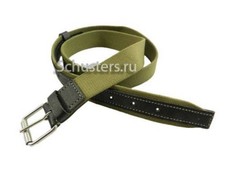
Stephende Wrote:Note that he is still wearing his navy belt. Still a sailor at heart.
Maybe that is true, maybe not.
If he wanted he would have got a buckle in Gold with inlayed Diamonds,
Proud of his navy career I doubt it he was an office guy.
Eddie.