Taken from:
Wrangel Island - New World Encyclopedia
In 1926, a team of Soviet explorers, equipped with three years of supplies, landed on Wrangel Island. Clear waters that facilitated the 1926 landing were followed by years of continuous heavy ice blocking the island. Attempts to reach the island by sea failed and it was feared that the team would not survive their fourth winter.
In 1929, the Icebreaker Fyodor Litke was chosen for a rescue operation. It sailed from Sevastopol led by captain Konstantin Dublitsky. On July 4, it reached Vladivostok where local staff replaced all Black Sea sailors. Ten days later the Litke sailed north; it passed Bering Strait, and tried to pass De Long Strait and approach the island from south. On August 8 a scout plane reported impassable ice in the strait, and the Litke turned north, heading to Herald Island. It failed to escape mounting ice; August 12, the captain shut down the engines to save coal and had to wait two weeks until the ice pressure eased up. Making a few hundred meters a day, the Litke reached the settlement August 28. On September 5, the Litke sailed, taking all the "islanders" to safety. This operation earned the Litke the order of the Red Banner of Labour (January 20, 1930), as well as memorial badges for the crew.
In the 1930s, Wrangel Island became the scene of a bizarre criminal story when it fell under the increasingly arbitrary rule of its appointed governor Konstantin Semenchuk, who controlled the local populace and his own staff through open extortion and murder. He forbade the local Eskimos to hunt walruses, which put them in danger of starvation, while collecting food for himself. He was then implicated in the mysterious deaths of some of his opponents, including the local doctor. The subsequent Moscow trial in June 1936 sentenced Semenchuk to death for "banditry" and violation of Soviet law.
During and after World War II, many German SS prisoners of war and the remnants of Andrey Vlasov's Russian Liberation Army were imprisoned and died on Wrangel Island. A prisoner who later emigrated to Israel, Efim Moshinsky, claims to have seen Raoul Wallenberg there in 1962.
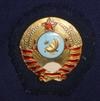
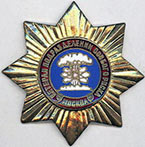
Shown below is the badge of the 1929 rescue expedition - a similar badge (the second one) for a different 1928 rescue mission sold at the M & E Auction # 31 for 19,000 GBP on Friday 13 June 2008.
No wonder these sort of badges are faked!!!!
Simon