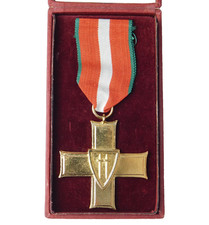
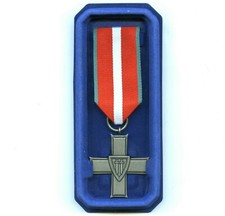
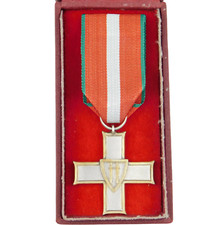
09-11-2004, 11:28 AM
OK guys, here's a translation from the french edition:
Institued in november of 1943, on behalf of People's Guard High Command, and confirmed by decision of People's National Concil on february 20, 1944 (act published in the "Rada Narodowa" nr7 and then by decret of CPLN on december 22, 1944 (Law Journal nr 17, 1944, art.91).
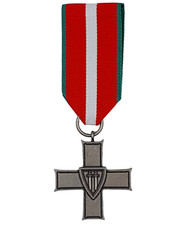
This order's history is not ordinary because it was instaured during the hardest fights lead by partisans against hitlerian occupant. The numeric increase of partisans squads coming from the left movement of clandestine fight in the occupied country, made necessary the need of new symbols caracterizing the People's Guard, then National Army, soldiers ideology. Th new symbols were gradually placed on banners and insignias of these regiments. And by the middle of 1942 were applicated new forms of distinction:three degrees of praise expressed by the People's Guard High Command.
By may 1943, the People's Guard General Staff commander, Franciszek Jozwiak, ps. "Witold", decided to create a new military decoration. His proposal had been agreed by the Polish Workers Party direction, and the name and the insignias have been created. In the projetc authors ideas, the new decoration for soldiers from polish left should emphasize the national caracter of their units and their fight goals. It was decided that name and symbols of the projected decoration will take up again with the traditions of fights lead by Polish against teutonism, and with the Grunwald victory of 1410.
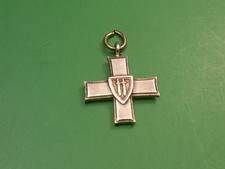
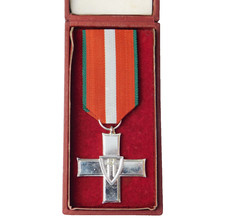
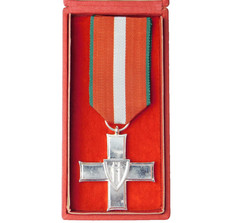
The insignia project was left with commander Stanislaw Nowicki, ps."Felek", chief redactor of People's Guard clandestine organa "Gwardzista" and member of the P.G. General staff. The first project, uncompletely finished, saw the daylight by the middle of 1943. After a debate, the decoration received the name of GRUNWALD CROSS. The document introducing the decoration was the P.G. reglement of november,1943, which stated: "the Grunwald Cross is a polish award confered for heroic deeds in the armed fight against occupant for Poland Freedom and Independance".
The reglementation confirmed the previous three degrees distinctions, decsribed the way to bear it, the dimensions (1st class: 30mm ribon; 2nd cl.: 20mm ribbon;3 rd cl.: 15mm ribbon wide) and the white-red ribons colours which were decerned instead of insignias in elaboration processing. It defined also the right of awardees to a promotion - simple awarded privates progressed to the corporal rank, seargents to lieutnant. During a solemn call, the awardees receive the diploma for which they distinguished themselves. The diplomas only stated the soldiers pseudonyms, not the names.
The following document - the N.P. High Command General Staff order, dated of january 1st, 1944, and published in "Gwardzista" nr36 of december 25, 1943, defined the attribution conditions of all differents order classes: the first class was decerned for "eminent services in organizing polish armed forces, for great military operations lead with success, and for the Grunwald Cross second class awardees, for multiple personnal heroic deeds". The class II was confered "for a remarquable commanding during fighting, for devoted activity in the organisation of polish armed forces, and for the IIIrd class Grunwald cross awardees, for personnal heroic deeds". The III class was given "for personnal heroic deeds on the battlefield or in clandestine activity".
On february 20, 1944, the People National Council confirmed, following a proposal of general Rola-Zymierski, Commander-in-chief of People's Army, the People's Guard Command decisions. The People's Council resolution, which was the Order's foudamental juridic act, stated that "the GRUNWALD CROSS is a military award". It precised the qualification of acts and services which deserved the different class awarding. The first class could be confered "for a victorious direction for great miltary operations , for important and eminent services in organizing of armed forces and clandestine fight". The IInd class - "for a unit eminent commanding on the battlefield, for commanding a partisan squad and for eminent services in clandestine activity". The IIIrd class - "for personnal heroic deeds on the battlefield or in clandestien activity".
the next episode following...;)
Sebastien
"a spectre haunts Europe, the spectre of communism"
(a well-known german bearbed)
"a spectre haunts Europe, the spectre of communism"
(a well-known german bearbed)