This was the highest institution of military education in the GDR.
Officialy founded on the basis of the former "Hochschule für Offiziere" of the KVP on 5th January 1959 in Dresden. Interestingly the Commander of the school from 1953-1958 before it changed was Wehrmacht Oberst Wilhelm Adam ( NVA Generalmajor ) the former adjutant of the German 6th Army at Stalingrad under General Field Marshal Paulus. Adam won his Knights Cross on the 17th December 1942.
In December 1959 the training of(Luftstreitkräfte/Luftverteidigung ,LSK/LV) Air Force and Air Defense officers began.
Commanders of the Academy ( From 1st September Chief of the Academy)
Oberst Wilhelm Adam (1953-1958)
Generalmajor Heinrich Dollwetzel (1st Oct 1958-30th Sep 1959)
Generalmajor Fritz Johne (1st Oct 1959-31st May 1963)
Generalmajor Heinrich Heitsch (1st June 1963-30th Apr 1964)
Generalmajor Hans Wiesner (1st May 1964-10th Dec 1986)
Generalleutnant Manfred Gehmert (11th Dec 1986-28th Feb 1990)
Generalleutnant Hans Süß (1st Mar 1990-30th Sep 1990)
Oberst Gerhard Kolitsch (1st Oct 1990-2nd Oct 1990)
Friedrich Engels
Friedrich Engels (November 28, 1820, Wuppertal – August 5, 1895, London), was a 19th-century German political philosopher who developed the communist theory alongside his better-known friend Karl Marx, co-authoring The Communist Manifesto (1848). Engels also edited several volumes of Das Kapital after Marx's death.
Variations
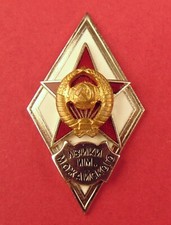
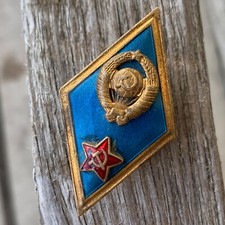
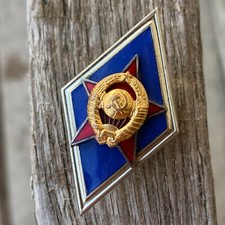
(1962- 1975) Typical for all the early GDR Academy Badges the medallion was placed central in the badge. It was emamelled and had the wording Military academy on the top edge. Screwback.
(1975-1985) The second generation Academy Badges had the medallion in the top half of the Badge. Below are the letters NVA and it was enamelled. Screwback
(1985-1986) This badge had the same design but it was lacquered. Screwback.
(1987-1990) This was the last variation of the badge and only had the medallion. This type was lacquered and was produced in screwback and pinback.
Eddie.
Everybody's equal, But some more than others!
"Those who come to us with the sword - will be killed by the sword" - Alexander Nevski
"Those who come to us with the sword - will be killed by the sword" - Alexander Nevski