04-25-2005, 08:57 AM
Take a look, a dealer from NJ just listed this group:
Suvorov 1st cl,
two Khmelnitsky 1st cl,
Kutuzov 1st class,
many other Soviet and foreign awards, documents, research, uniform, etc!!! - for $360,000
This is awesome group, but who can afford to pay this kind of money??!!??
Description:
"Complete documented group of 42 decorations to Col. General Ivan Bulychev. Includes an Order of Suvorov 1st cl., two Orders of Bogdan Khmelnitsky 1st cl., an Order of Kutuzov 1st cl. and a Kutuzov 2nd cl. Comes with extensive archival research. Extraordinary historical group of highest Soviet military decorations, unique in its composition.
Two Orders of Bogdan Khmelnitsky 1st is the largest number ever awarded to the same individual, and Bulychev is among only four people that have received more than one. At least one of the other three groups has been broken up, with decorations sold separately. As of the end of last year (the latest information we have) not a single museum in the world had a group that includes two Khmelnitsky 1st cl. It is highly improbable that another group such as this one will appear on the open market again in the forseeable future.
Soviet Orders: Order of Suvorov 1st cl., Type 2 Var. 2, #440, May 1945 issue;
Order of Kutuzov 1st cl., Type 2 Var. 2, #160, April 1945 issue;
Order of Bogdan Khmelnitsky 1st cl., Var. 1 (with 3 rivets), #143, August 1944;
Order of Bogdan Khmelnitsky 1st cl., Var. 2 (with 2 rivets), #274, December 1956 issue for the invasion of Hungary;
Order of Lenin, Type 5 Var. 2 (without a "dimple"), #24257, February 1945;
Order of the Red Banner Type 3, Var. 2 #29232 duplicate (serial number altered at the mint), issued in exchange for the May 1942 screw back;
Order of the Red Banner, Type 3 Var. 1, #139041, November 1944;
Order of the Red Banner 3rd award, Type 3, #3897, June 1947;
Order of the Red Banner, Type 4, #527095, 1963 (for executing a classified "special task");
Order of the Patriotic War 1st cl., Type 2 Var. 1, #16494, mint reissue for the September 1943 suspension type;
Order of the Patriotic War 1st cl., Type 3, #512865, 1985;
Order of the Red Star, Type 2, #11829, mint reissue for the lost piece, originally awarded in June 1940;
Order of the Red Star, Type 2, #3615511, February 1968;
Order of the Red Star, Type 2, #3713237, August 1987 issue (to commemorate the 70th anniversary of the October Revolution)
Order of the Red Banner of Labor, Type 6 Var. 1, #409427, June 1961.
The first Order of the Red Star has enamel replacement to a portion of the lower right arm. All other decorations are in excellent condition.
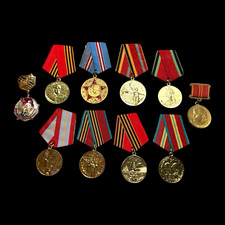
Soviet Medals: For the Liberation of Prague; For the Capture of Berlin; For Victory over Germany; For 20th Anniversary of RKKA; For 30th Anniv. of the Soviet Army and Navy; For 40th; 50th and 60th Anniv. of the Soviet Armed Forces; For 20th, 30th and 40th Anniversary of Victory over Germany; Armed Forces Veteran's Medal; For 800th Anniversary of Moscow; For 1500th Anniversary of Kiev; Lenin Centenary Medal (military issue).
Polish Decorations: Order of Virtuti Militari, 5th cl.; Order of Grunwald, 3rd cl.; Medal for Liberty and Freedom; Medal for Oder - Neisse - Baltic Campaign.
Czechoslovakian Decorations: Order of the White Lion, 2nd cl.; two Orders of the Cross of Valor; Dukla Pass Medal; Medal for 20th Anniversary of Slovak National Uprising of 1944.
Other Awards and Badges: Chinese Medal for Sino-Soviet Friendship; Soviet Badge for 25th Anniversary of Victory; Supreme Soviet of RSFSR Membership Badge, #496, 1950s-60s; Frunze Military Academy Graduate Badge, 1950s issue in silver.
Documents: order booklet listing WW2 and 1950s decorations (contains nice photo of the recipient), 1946 issue; order booklet for the Red Banner of Labor and last Red Banner, August 1961 issue; order booklet for the second Red Star, 1968 issue; order booklet for the third Red Star, 1987 issue.
All documents are in excellent condition.
Research Materials: Xerox copy of complete archival records of decorations, including foreign awards.
Xerox copy of personnel file through the late 1930s. Interestingly, the WW2 and further records of service were not available from the archives and must still be classified.
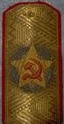
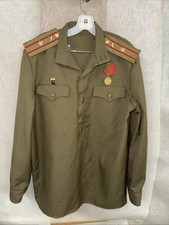
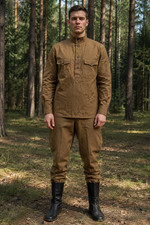
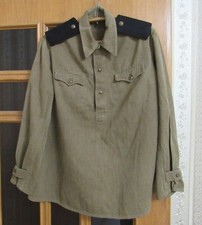
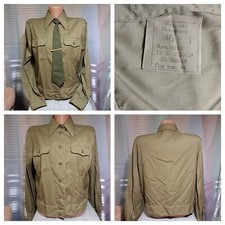
Also Included: Bulychev's General's full dress tunic. In highest quality wave blue wool wool, double-breasted. Gold embroidery on lapel and cuffs, with early style embroidered silver stars on shoulder boards. Holes and indentations perfectly matching the decorations of this grouping.
This group is continued.
$360,000.00"
"Ivan Bulychev was born in 1897 in Moscow. His family, originally farmers from Kaluga region, soon moved back to the village where his father worked as a baker. After finishing a village school, Ivan Bulychev changed several jobs in Moscow until finding one that allowed him to receive a vocational education. In 1915 he volunteered for the army and was soon sent to study at a military technical school in Riga. Upon graduation, he became an instructor at the same school.
In 1917 he took active part in the October Revolution. As a Red Guard in Dybenko Unit, he fought against the Germans at Prokhovo, Narva and Yamburg in 1918. In 1919 he joined the regular Red Army as a platoon commander in the 34th Division. By June 1920 he rose to company commander, then was appointed the inspector for signal service in 9th Kuban Army. He commanded a Signal Battalion in 31st Rifle Division during the period of September 1920 through July 1921.
In June - October 1921 Bulychev served in the famous 1st Cavalry Army as commander of signal service of 14th Cavalry Division. Although an accomplished signals specialist by that time, in March 1923 he was put in charge of a regular infantry regiment of the Kiev Military District. This was probably the result of the reshuffling of officers that came after the end of the Civil War. Bulychev held this post until October 1927, at which time he entered the prestigious Frunze Military Academy.
Upon the graduation in 1930 he was appointed Commander of Signals, Ural Military District - a very high position that he held until 1934. He distinguished himself in this capacity, and in 1934 was awarded with the Honorary Certificate of the Central Executive Committee of the USSR. This was an extremely high honor, akin to receiving the Title of Hero of the Soviet Union (the certificate itself is very similar in format to the "large" Hero's certificate).
This group is continued.
"
"During 1934 - 1935 Ivan Bulychev took another study course at the Frunze Military Academy, and after that served again as signal service commander, this time of Kharkov Military District. In 1936 he was promoted to Brigade Commander and became Assistant Commander of the Signal Department of the Red Army.
Bulychev came relatively unscathed through the infamous purges of the military in 1937-38, with only a party reprimand for "contacts with the enemies of the people". Perhaps it helped that back in 1933 he received severe service reprimand from Tukhachevskiy, one of the top Soviet military commanders denounced as traitors and executed on Stalin's order in 1937. It is obvious however that Bulychev did come under intense scrutiny, and had to explain minute details of his biography in numerous explanatory notes and memos (copies of some of them are included in the personnel file).
Nevertheless, by 1940 Bulychev's career was fully back on track: in August of that year he was promoted to Signal Corps Major General. Unfortunately, the available archival records on Ivan Bulychev end just before the beginning of the Patriotic War - much of his later service information are probably still classified. It is known however that for much of the war he served as a Deputy Commander or Commander of Signal Corp of several key fronts. He participated in the Battle for Berlin as Commander of Signal Corps of the 1st Ukrainian Front. For that task, he received high praise from the front commander Marshal Konev in his me***r "Nineteen Forty Five".
By 1946 Colonel General Bulychev rose to become assistant commander of the Chief of Signal Troops of the Soviet Land Forces. In 1956-1958 he received his highest commission, as the chief of Signal Troops of the Soviet Armed Forces, the highest possible post in the Soviet Signal Corps, and a position of great prestige and responsibility.
"