12-07-2009, 03:15 PM
Both preserving and storing are problems. Worse than uniforms.
This is what makes awards so attractive. ;)
This is what makes awards so attractive. ;)

 How do you preserve flags?
|
How do you preserve flags?
|

12-07-2009, 03:15 PM
Both preserving and storing are problems. Worse than uniforms.
This is what makes awards so attractive. ;) 
12-07-2009, 04:02 PM
I keep my uniforms in the attic and in the wardrobe; they are space-consuming but I can live with that as I enjoy my hobby. They all hang on hangers. The flags are folded in boxes. Not the best solution but until I have a large room where I can have them hanging from the ceiling; that would have to do.

12-07-2009, 04:57 PM
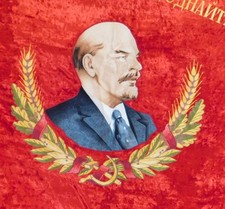
A friend of mine had a flag (not soviet, but had a similar construction and materials). He kept it hanged in the wall and every weekend he cleaned it with a soft brush to remove dust from the velvet.
Santiago´s air is very dirty; it has this dark, sticky black dust that impregnates everything in our homes every two or three days after cleaning. And worst of all, it simply loves to stick in velvet and cloth wrinkles. He didn´t have the space nor the money to preserve it in a better way (like displaying it on a piece of glass or acryilic) and finally got tired and sold it :D
There's nothing in the streets
Looks any different to me And the slogans are replaced, by-the-bye And the parting on the left Are now parting on the right And the beards have all grown longer overnight The Who, Won't get fooled again 
12-12-2009, 03:34 AM
I had the opportunity, several years ago, to visit the flag storage facility at the Museum of the Confederacy in Richmond, Virginia. It was a private tour afforded me by the flag curator for some work I had done for a heritage-type organization. It was quite impressive both with respect to the conservation techniques and the flags themselves. As has been pointed out, elements in the air, folding and light all degrade a flag over time. Also, temperature and moisture in the air will have a damaging effect. The severity of these aforementioned elements will, also, depend on the material used in the flag. Silk (real) looks great but seems to be the least archival- just doesn't last. In the Museum, silk flags are put between layers of mylar- they aren't touched- and when the other side is needed to be viewed (very often, earlier flags had different images on the other sides), the mylar is "rolled" until the other side is "up". Cotton dries out and crumbles and, therefore, must be handled in much the same way. But, a material called "wool bunting"- the material used on most of the Northern Virginia issued battleflags (the square flags with the X) seems almost indestructible and were, at the time of my visit, loosely folded and piled in a corner of the space. A great material although quite heavy- these flags needed a pretty good breeze to send them "flapping"- but very sturdy. Also, they don't seem to fade at the rate the others do.
So, according to the Museum's conservation practices and depending on the material; climate control (humidity), exposure to unfiltered air, exposure to light and handling (folding) are all considerations for flag maintenance.
"We are Marching for the Victory of Communist Labour"
V.I. Ulyanov (Lenin) 
12-18-2009, 11:43 AM
(This post was last modified: 12-18-2009, 11:46 AM by Bill Garvy.)
From my experience, folding appears to crease the wool bunting. I roll my Soviet naval flags and store them in air tight bags.
|
|
« Next Oldest | Next Newest »
|