03-14-2004, 11:34 PM
Guys,
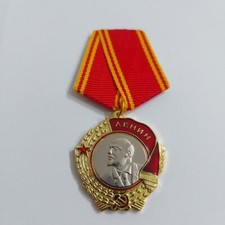
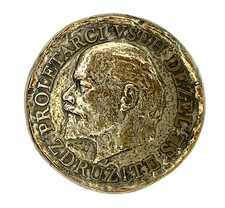
Here's another one with the serial number above the rivets.
Alexei
Here's another one with the serial number above the rivets.
Alexei

 Lenin.
|
Lenin.
|
 
03-15-2004, 05:34 PM
I just wanted to add that I am currently cataloguing all orders and medals with all types and variations using as many sources as I can (Art's website, McDaniel, Markov, Mondvor website, etc.) and very often I found different types/variations than what is commonly used here and in McDaniel book.
To name just few, I remember seeing a variation of Ushakov medal with a different patina (gold / brownish), a Kutuzov 3rd class with horizontal lines in the Spassky Tower and another variation without these horizontal lines... There is also Nevsky (Type 3 if I remember) which has 2 variations. One with the rings from helmet touching the border of the circular medallion and one not touching.. also there was a difference in the tip of the helmet... There was also many other orders/medals with "new" variations, but I just don't have them in mind now. Anyway, all this to say that it comes to a dilemma when it's time to decide what should be a type/variation by itself or what should be included in a type/variation. We want to be detailed and specific enough but at same time, we want don't want to get lost into too many types/variation, with some of them having only 1-2 pieces ever observed. I know that there is no a single way to categorize the awards, but I like McDaniel's way a lot and it's very well known. However, it seems more and more that it's not up to date, or at least not specific enough (this is my opinion!) This leads me to few questions: What is a Type? What is a variation? What is a subvariation? Here is what I have for now, please feel free to comment and add your ideas/suggestions. I don't intend to know a lot and this is why I decided to start creating my own "catalogue". I find it's a very interesting way to improve my knowledge. Hierarchy of classification I use: 1. Item (with class* if any) 2. Type 3. Variation 4. Sub-variation Type (what difference make a new/different) -------------------------------------------- - suspension (screwback or with suspensions, early or late rectangular suspension, etc..) - Number of pieces in maknig of the award (generally have different number of rivets too) - Difference in shape/size of the awards (like ORB circular and ovals) Variation (what differences make a new/different) ----------------------------------------------- - Ring shape (circular, upside-down "U", flat with grind marks, etc...) - Ring attach to medal (soldered, as part of the medal) - Mint (Goznak, Mondvor, Monetnyi Dvor, Leningradskyi...) - Method of serial numbering (stamped, hand, rotating tool) - Serial numbered or not (like the combat service and bravery) - Material made of (usually for medal: silver, silver plated, nickel-silver, etc...) - Difference in shape of the reverse (concave starback, mirror, etc...) Sub-variation ((what differences make a new/different) ----------------------------------------------------- - Style of the mint mark (in straight line, curved, 1 or 2 lines, etc..) - very slight difference in the pattern (like some lines longer, shorter, etc..) - location of the mint mark or serial number on the reverse of the award (top, bottom, over or under rivet, etc.) Unfortunately, I am at work and don't have my notes with me and this I what I can remember for now. * "CLASS" are always one level higher than types in categorizing. 
Yakovlev's work brought him prominence. He was made a Hero of Socialist Labor, and was awarded the Order of Lenin, 100,000 rubles, and a car.
Alexander Sergeyivich Yakovlev was born on 6 March 1906 in Moscow. He grew up tinkering with model airplanes and gliders, and after graduating from secondary school went to work in an airplane factory as a mechanic. Yakovlev proved to have an aptitude for designing and building aircraft. In 1926, he produced his first aircraft, a small two-seat biplane he named the "AIR-1", later redesignated the "VVA-3". The Soviet military was so impressed with the AIR-1 that Yakovlev won admission to the Shukovski Aviation Academy in 1927. Yakovlev graduated in 1931 and joined the Polikarpov design bureau, where he worked on building more light aircraft. An accident with one of his aircraft resulted in his dismissal, but Yakovlev lobbied Communist Party officials to let him start his own organization, and in 1934 he was granted use of an old abandoned bed factory to establish his own design bureau ("OKB" in the Russian acronym). The Yakovlev OKB focused on sport and training aircraft. The most prominent of these aircraft was the "UT-2", which first flew in 1935. This was a two-seat primary trainer with the same general configuration as the American Stearman PT-26. The UT-2 had very pleasant handling characteristics, and 7,243 would be built up through 1946. Yakovlev also built a single-seat advanced aerobatic trainer, the "UT-1", a stubby little aircraft with broad similarities to the American Boeing P-26 "Peashooter". The first UT-1 flew in 1936, and 1,241 would be built. Some of them would be pressed into combat service during the war, carrying two 7.62 millimeter Shpital'ny-Komaritsky (ShKAS) machine guns and four RS-82 82 millimeter rockets. Yakovlev's work brought him prominence. He was made a Hero of Socialist Labor, and was awarded the Order of Lenin, 100,000 rubles, and a car. He gain access to Stalin, and in April 1939 the Great Leader handed him a challenge. Stalin wanted a prototype of a new high performance fighter in months. Yakovlev protested: "But the Americans take two years to produce a fighter!" Eddie.
Everybody's equal, But some more than others!
"Those who come to us with the sword - will be killed by the sword" - Alexander Nevski
Rocket Designer Vladimir Utkin Doctor of Engineering sciences and Professor. For his hard work he was awarded with a golden star of the Hero of Socialist Labor (twice) and six Lenin orders.
Thought he was worth a mention with six Orders of Lenin. Vladimir F. Utkin was born in 1923, October 17, Ryazan' region, Russia. He is a well-known scientist, general designer of strategic missiles, launch and space vehicles, the director of the Central Research Institute of machine building of the Russian Aeronautics and Space Agency , Academician of Russian and Ukrainian Academies of Sciences, International Space Academy, president of Tsiolkovsky Academy of Cosmonautics, doctor of engineering sciences. Vladimir F. Utkin - one of these men on which the defense of Russia is based. Vladimir F. Utkin headed Yuzhnoe Design Bureau in Dnepropetrovsk (Ukraina) from 1970 to 1990 as the chief and then the general designer. Four strategic missile complexes were developed, some launch vehicles were created under his leadership. Among them - the highly effective, ecologically pure Zenith launch vehicle; SS-18 and SS-24 strategic missiles. He implemented many defense and scientific projects in the field of space researches. More than three hundred satellites of Cosmos - type of Yuzhnoe Design Bureau development were launched in the orbit. Application of defense scientific and technical development in the interests of science and national economics is the characteristic principle of Utkin's business. So, on the basis of the SS-9 ballistic missile he designed the Tsiklon launch vehicle for putting in the middle payload orbit. The Ñosmos-1500 satellite was used to navigate convoys of ships in the ices of East-Siberian sea. Ñosmos-1500 also became forefather of the well-known Ocean satellites ensuring high safety and efficiency of navigation. Since 1990 Vladimir F. Utkin has been the director of the Central Research Institute of Machine Building of the Russian Aeronautics and Space Agency. The Federal Space Program of Russia is developed at the direct participation of Vladimir F. Utkin. Research and development works on special experimental devices, scientific and technical support of key problems connected with the International Space Station (ISS) is provided under his management, as the general designer. The merits and experience of Vladimir F. Utkin, his authority in the world, have mostly determined his assignment as co-chairman of expert commissions, well-known as Utkin - Stafford commissions, exercising the mutual control over the problems of the ISS creation. Vladimir F. Utkin heads the coordination scientific and technical council of and Russian Academy of Sciences on researches and experiments at the Mir orbital station and Russian segment of the International Space Station (ISS). Vladimir F. Utkin is the author of more than 200 publications and great number of inventions. He has 11 awards and 14 medals, twice the Hero of Socialist Labor (one of the highest former USSR awards), winner of Lenin and State premiums. Eddie.
Everybody's equal, But some more than others!
"Those who come to us with the sword - will be killed by the sword" - Alexander Nevski 
03-18-2004, 06:04 AM
Hello
Just wondering I have an order of lenin with order book and HSL with no docs, is it possible to find out more info as to why they got them, and who for my HSL. From some data base some where or from Russian military, civilian archives?? Does any body have access to this info? Soviets where good at keeping records on just about anything, I figure this info must be available somewhere. How do I get it? Thanks Ron B 
03-18-2004, 09:24 AM
Ron,
In most cases it's not possible to research civilian awards. Archives for HSL exist, but they're closed for access. William 
10-01-2004, 01:21 AM
Is it possible to have an Order of Lenin without a serial number? Unissued?
10-03-2004, 11:07 PM
Danny,
They get stamped at the mint, so even an unissued piece (with no wear) will have a serial number. Alexei
01-05-2005, 07:09 PM
Were the Orders of Lenin ever used as a long service award? If so, when did they stop using them as such. Thanks
|
|
« Next Oldest | Next Newest »
|