

03-07-2008, 12:35 PM
I (and presumably the PhD holder(s)) thank you.

 Lenin.
|
Lenin.
|

03-07-2008, 12:41 PM
Yes, many thanks. This is what I guessed all this techno-speak was saying, but it is good to hear it expressed in English.
Interesting, and it is always good to learn things. And to see that there are still things to learn. I am away from reference books just now, but should we assume that the observed serial number ranges for the "gold head" and "silver head" Lenins overlap? At least with Mongolian stuff (except the Polar Star, which lives on its own plane of existence), that is usually a good indicator for sub-varieties that aren't. When asserted varieties can be "ground-truthed" against observed serial numbers (and, even better, documented dates of award) we can start to learn some new things even through low-tech methods. Thanks again. 
03-07-2008, 09:46 PM
Since any good scientific studies needs to be repeatable, I am proposing that all the collectors with "Gold head" Lenins and silver headed Lenins send them to me ASAP and I will attempt to repeat the procedure at some point at a later time.
Before I continue however, can anyone lend me a SEM? :laff :laff :laff :laff :laff On a serious note, great information! I am continually amazed at the knowledge and brainpower of people in the forum and even more happy you are willing to share your knowledge and experience with the rest of us. It is very much appreciated. 
03-11-2008, 01:01 PM
I think this method will be very helpful... and I assume you have already thought of this:
It would seem to me that one needs to know the exact ingredients of each "batch" of gold alloy, to insure that Ag (Silver) isn’t apart of that batch's original alloy… or one may introduce bias into one’s conclusions as to measuring the remnants of a silver coating. Or: If one takes multiple samples across the surface, and finds large silver free zones along with the indication of silver in the “no wear” zones, then one can conclude the evidence of silver plating. Knowing the alloy would rule out the possibility of non-homogeneous mixes, to know if silver could contaminate your readings by being apart of some or all of the alloys used, and having to make "large" samplings of these older OL to demonstrate your point.
"Те, кто забывает историю, обречены повторить это снова."

08-09-2008, 03:53 PM
Hi!
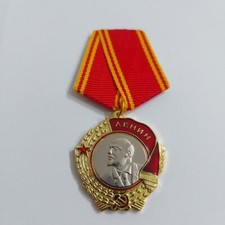
I'm planning to get an Order of Lenin for my fledgling collection. Money being scarce I thought I'd begin with an affordable variation. What would you guys say that a reasonable price for a "basic"/common version of the order would be? I repeat; it doesn't need to be special, rare or anything. Also, where on the internet should I look for these? I live in Finland where ALL variations fetch 1000 € and upwards!! PS: I know this isn't the marketplace, but if anyone has an affordable Lenin for sale, feel free to send me a message.
08-09-2008, 04:37 PM
Today the melt value of a Lenin is €600-€700.
A piece of bog standard jewelry made today often has a mark up of more than 50% over the melt value. So by any measure €1000 is much more than reasonable!
Steiner: "Why do you want it so badly? It's just a worthless piece of metal. Look."

08-09-2008, 04:47 PM
Guys,
Simply look around what a common OL goes for; lately, it's been close to $3,000 (~€2,000) Marc
03-26-2009, 03:57 AM
Anyone know what the metal content, specificly the gold content, is for an order of lenin?
|
|
« Next Oldest | Next Newest »
|