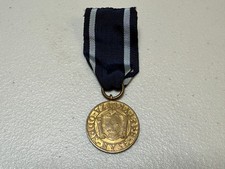
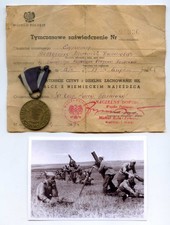
This medal was instituted on October 26, 1945 by decree of the National Council (Krajowa Rada Narodowa). It was awarded to soldiers of the People's Army, operating in the former German territory which would become Polish after WWII.
It is a Gilded Bronze Medal 33 mm in diameter
The obverse shows a map of Poland with the cities of Gdansk, Szczecin, Wroclaw and Warsaw marked on it. The map is surmounted by a non-crowned eagle and circumscribed ZA ODRE-NYSE-BALTYK (for Oder, Neisse, Baltic). On the reverse is an inscription RP / ZWYCIEZCOM (to the victors) / III.1945 / IV.1945, all the words are underlined.
The ribbon is dark blue with light blue side stripes and 35 mm wide
Eddie
Everybody's equal, But some more than others!
"Those who come to us with the sword - will be killed by the sword" - Alexander Nevski
06-25-2006, 10:48 PM (This post was last modified: 07-01-2006, 11:26 PM by d-riemer.)
Welcome back, Eddie. I missed you. I am glad that you are continuing where you left off.
320,000 Odre-Nyse medals have been issued. The interesting part is the fact that there are two types that are hardly ever reported. The initial issue shows only the Odre-Nyse area with some rivers. The later, more common medal adds some of the new borders of postwar Poland and the large cities Szczecin (Stettin), Wroslaw (Breslau) and Gdansk (Danzig) - identified by the Polish initial - in the newly acquired land. The border was fixed at The Potsdam Conference held at Cecilienhof in Potsdam, Germany, from July 17 to August 2, 1945.
06-25-2006, 10:55 PM (This post was last modified: 06-25-2006, 11:06 PM by Taz.)
Hello Dietrich, :)
Thanks its good to be back, nice info once again ;)
The border between Germany and Poland is a story in itself.
On November 14, 1990, after German reunification, the (extended) Federal Republic of Germany and the Republic of Poland signed a treaty confirming the border between them, as requested by the Treaty on the Final Settlement With Respect to Germany. Earlier, Germany had amended its constitution and abolished Article 23 of West Germany's Basic Law, the one used for reunification, which could have been used to claim the former German eastern territories as well. During this period Helmut Kohl the Chancellor of Germany refused initially to recognise the Polish border and serious diplomatic attempts had to be made in order to secure German agreement towards final settlement. The 1990 Polish-German border agreement finalizing the Oder-Neisse line as the Polish-German border came into force on January 16, 1992 together with a second one, a Treaty of Good Neighbourhood, signed on June 17, 1991, where the two countries among other things recognized basic political and cultural rights for both German and Polish minorities living on either side of the border. (Approximately 150,000 ethnic Germans still reside in Poland, mainly in the Opole Voivodship, with smaller presence in regions such as Silesia and Masuria, and one and a half milion Poles in Germany.
Eddie.
Everybody's equal, But some more than others!
"Those who come to us with the sword - will be killed by the sword" - Alexander Nevski