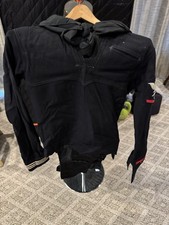
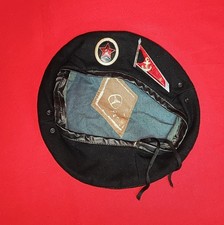
I don't normally buy uniforms off of Ebay, but the price was good and the item looks period to me. What are your thoughts? What type of shirt should be worn under this? I know that enlisted wore the black beret and the hooped shirt/jumper. What about officers?
07-31-2013, 05:33 PM (This post was last modified: 09-17-2013, 06:40 PM by CtahhR.)
Thanks for the input. I need to obtain the cream colored shirt. The tie is black, matching the jacket, right?
The jacket came in. The buttons have the 1984 date. He must have worked in a factory during the war, as a kid. All of the insignia and ribbon bars are sewn on. The ribbon bar is made from a flexible material. There is one small hole on the other side for an Academy badge. I need to find one that will be pertinent to his active time period? Maybe the 1960s?
I like that he has the Homeland Defense Order, Third Class.
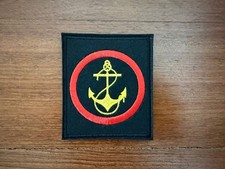
Question... going through the books I notice that the Naval Infantry wore a specific type of uniform. Were medical officers assigned to wear the navy pattern uniform, as seen above, or did they wear the specific four pocketed tunic?
PaulR Wrote:Question... going through the books I notice that the Naval Infantry wore a specific type of uniform. Were medical officers assigned to wear the navy pattern uniform, as seen above, or did they wear the specific four pocketed tunic?
The uniform You describe was worn only as a field uniform (sometimes everyday) on most of the non-combat ocassions the naval infantry officers wore standard navy uniforms with just the boards piped in red. Also, medical officers of all the navy wore red piping during that period - not olny marine.
Al-muell Wrote:The uniform You describe was worn only as a field uniform (sometimes everyday) on most of the non-combat ocassions the naval infantry officers wore standard navy uniforms with just the boards piped in red. Also, medical officers of all the navy wore red piping during that period - not olny marine.
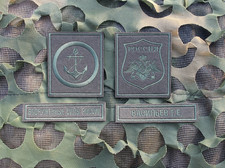
I am thinking that there is a possibility that this could have been a standard naval medical officer that someone added the patch to the shoulder? Either way, the price was really inexpensive, so I am happy. Here are more photos.
I am afraid that there'sno way to proove either way.
Supposing that this set is not put together, it would indicate that the officer begun his service no sooner than 1945 (lack of VoG and prasence of Labour Victory indicates non-combat participation in the GPW) and no later than 1947 (the CSM seems to be for 10 years of service, as there are only 20 and 15 years irreproachable service medals). The armed forces veteran medal ssems to indicate that he served for atleast 25 years, which means that his service ended no sooner than between 1970 and 1972 and that he has probably NOT served on any submarine. Not unusual for a military doctor to have served more than 25 years, and even tough retirement age for colonel was set to 50, he could have served a bit more. From 1969 to 1988 the special Naval Infantry uniform was only a field uniform (since 1988: everyday), so this uniform is OK as an everyday uniform of a naval infantry medical service colonel from around 1970.