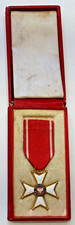
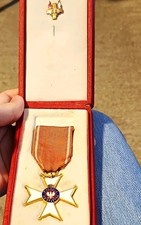
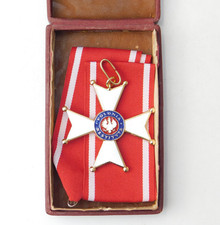
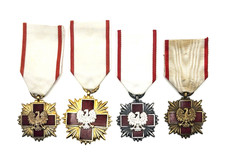
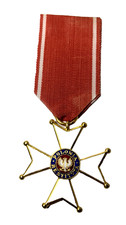
You're sure they're the same grades? Maybe the gilt's worn of the first one?
"patina imparts character" - PJS
A wise man said: 'you should not pay a premium for what you want beyond your comfort level, and always ensure there is a mutually agreeable return policy.'
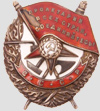
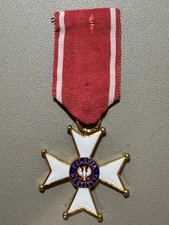
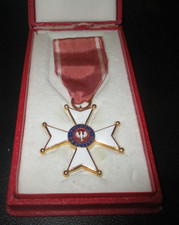
If you compare this site's images of the reverse of each class (5-2, no image for 1), you'll see a difference. The 3rd class is "shiniest," 2nd class "dullest". 5th class is also "dull." 4th class is bright but not "shiny".
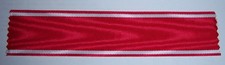
Attached are some more images from other sources (my collection and online). The first 4th class matches the luster of the piece on the Russian website. The second is "shiny". And the 5th class here is "shinier" than shown on the website.
Hm, generally after 1952 all PR orders were supposed to be made by the State Mint. Before, some were made in Moscow, some in Poland in various places, but I believe that it wasn't untill 1952 when they got the "1944" legend (altough I may be wrong).
On the other hand, before the war Polish servicemen had few types of uniforms and more than one required wearing medals. Some people found it convenient to sew the medals on the uniform, which would make removing them and putting on a different uniform uncomfortable and time consuming, so some people ordered award copies at engarvers' workshops. Even tough the variety of uniform types after the war has decreased, some people could have found this solution interesting.
But that's just a theory.
I will ask some experts, maybe they willput some light on it.
Anyway, all the lower classes I have seen have shiny backs, but so do the copies of 1st class.
Al-muell Wrote:Hm, generally after 1952 all PR orders were supposed to be made by the State Mint. Before, some were made in Moscow, some in Poland in various places, but I believe that it wasn't untill 1952 when they got the "1944" legend (altough I may be wrong).
On the other hand, before the war Polish servicemen had few types of uniforms and more than one required wearing medals. Some people found it convenient to sew the medals on the uniform, which would make removing them and putting on a different uniform uncomfortable and time consuming, so some people ordered award copies at engarvers' workshops. Even tough the variety of uniform types after the war has decreased, some people could have found this solution interesting.
But that's just a theory.
I will ask some experts, maybe they willput some light on it.
Anyway, all the lower classes I have seen have shiny backs, but so do the copies of 1st class.
Interesting ideas. I think the pattern is too widespread to be explained by veteran-ordered copies though. It'll be interesting to hear from the "experts."
Is this a question of authenticity? I doubt that's it since these are almost never faked. The only pair that I would wonder about is the 3rd class. (Do the two 3rd class examples look authentic?)
OK, as said - just a theory.
I am still awaiting answers, so we will see what the experts (long-term and dedicated polish award collectors, that is) say
An example of the award given for social activity - here in the Society of Common Knowledge (TWP) - for the whole activity - a "retirement gift" kind of award (PR granted a pension increase).
To Tadeusz Cybulski, TWP's Senior Educational Instructor
"Cit.[izen] Tadeusz Cybulski is working in the field of adult education from 1945: 1946-1948 in Jelenia Góra (principal of the professional training center), 1948-1949 in Wrocław, in 1951 in Lębork (principal of the State Professional Training Company) and since January 1st 1950 as a educational worker (sr. instructor) in the Voivodeship directorate of the TWP in Gdańsk, where he works till present. His duties were work in the area's centers of the Society - organizational work at the creation of educational centers and lecture points as well as work as an instructor.
Cit.[izen] Cybulski distinguished himself as an organizer of the network of Common Universities and other forms [of educational institutions], especially in the rural areas of the whole voivodeship, especially in the territory of the former powiats of Lębork, Elbląg, Kwidzyn and Wejcherowo. In the harsh conditions of the field work he always carried on well, putting a lot of effort and sacrificing his time not counting workhours. He shown much dedication in the educational work. He is a lecturer of the TWP in the socio-political and economical fields. For his activity, he was honoured by the Main Directorate of the TWP with silver (1960) and gold (1972) honorary badge "Meritous Knowledge Populariser". Since 1945 [he was] an active member of the PPS [the Socialist Party]and then the PZPR, former party's Lecturer. In 1956-1960 1st secretary of the Basic PArty Organization at the Voivodeship Directorate of the TWP. Trade union activist of the ZNP [Polish Teachers' Union]. For his participation in the defensive war of 1939 he benefits from the privillages of a veteran. He deserves the awarding."