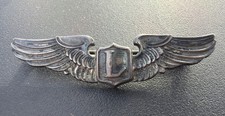
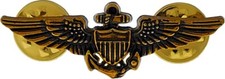
1. Are these wings given to all air force engineers or do they have to be flying to qualify.
My humble opinion would be that they are aircrew qualified, as these are flight badges and not just engineer qualification.
2. Is a navigator also a qualified pilot? I ask this because in some of the books I have read I see that qualified pilots acted in various positions.
MY HO. Normally the aircrew went from tail gunner to navigator to pilot if they were deemed suitable (my father did this in WW2 RAF) but not the other way around.
The Germans do have however a pilots and a pilot/observers badge.
I can see a pilot being used in other roles if in the extreme or if they held that position before being badged pilot.
3. Is there a distinction between the wings issued to bomber pilots and fighter pilots?
My HO. Good question. I do not believe so, but there is a variation between schools and air arms.
Monroe I am just starting to get an interest in aviation badges, these answers are based on my experience with the military.
I will ask some former Russian aircrew I know…. probably get a chance soon as I will be parachuting and the aircrew are all ex soviet trained (Russian Parachutes as well D6.)
Up until the end of WWII there were a huge number of different wings, as Chris said they were for different schools, services, etc.
After the war the became more standardized.
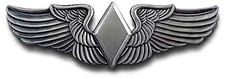
There were basically three types of wings - pilot, navigator and engineer. There were of course many wings when you take into account the different models/dates and the fact that some came in up to 5 classes of specialty (Master/Sniper, 1, 2, 3, and 0).
These wings were only for qualified flight personnel. This meant officer in almost all cases. So standard mechanics and even aircrew like gunners on the old 1950s-60s bombers did not get wings. A ground based engineer could have wings if he was qualified to operate as in-flight engineer.
Navigators were actually navigator/payload specialists - hence the original bomb shape for their wings.
Interestingly, there was no seperate naval infantry wings from the end of WWII until 1991. Naval pilots wore regular wings during this period. It was the development of actual carriers that prompted the navy to make its own badge. It is not clear if it was to be issued to all Soviet naval pilots or if shore based pilots would still use the standard wings.
Chris, your navigator's wings look odd. They appear to be M1950, the only type which had just the bomb (not the bomb on a shield) with numbers. However, the M1950 should have red enamel numbers set into the bomb, not a meal number affixed to the bomb. Also, the bomb should be very cuved (convex) and not flat.