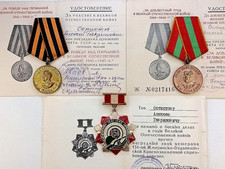
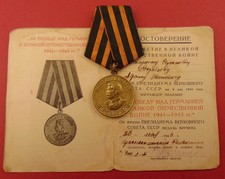
I hope you are right. Of of my groups have this document so it would be nice if that was true. But I'm not so sure about 10 000 awarded. The serial number on mine is 21 288. Perhaps it was just for a few chosen ones, the rest got the more common paper?
Hello, Gentlemen.
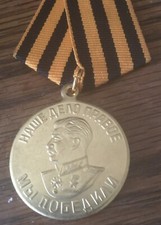
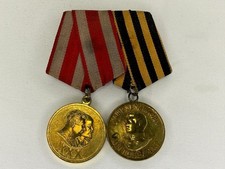
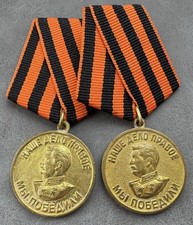
Here are two more medals I received today from a dealer on eBay. I believe one is a 1st pattern with the soldered, split suspension ring, and the other is a 2nd pattern with the flat, filed suspension ring. It looks like the 2nd pattern's ring is actually part of the medal rather than being soldered on like the 1st pattern's ring. Very happy with these pieces. My collection is growing. Here are some scans:
this photo actually shows the true colors of the medals. I must have lost lighting on the last photos.;The medals almost look silver.
closeup of the soldered suspension ring on the 1st variation and a closeup of the flat, filed suspension ring of the 2nd variation...
Wow! If this is an indication of how complicated this is going to be, I'll need some real help. More than me just studying one reference book. This is something! Thanks for the 'wake-up' to reality.
So are all of the filed loops 2nd variation or is it more complicated than that? Were the split rings the 1st variation?
It may seem confusing when your just starting out. The changing design of the award ring process is interesting because it reflects the changing nature in the craftsmanship of these awards.
For example, the variation 1 ring was soldered on. This is somewhat labor intensive. Consequent variations eliminated the soldering process, and as a result the rings were actually part of the medal. These other variations are distinct in their appearance and easily identified. The variation 2 ring has grind marks where the material of the front and back of the ring was ground off. This was to let the ring swing freely when it is attached to the suspension loop. The variation 3 ring was an attempt to make the ring look like the variation 1. The difference is that variation 3 is part of the medal, and not soldered on like variation 1.
BTW, you can see the different ring variations ( well a lot of them anyways ) on the different awards by visiting the main site and looking through the medals links.
Thanks, Art.
So then do all these different loop variations that Alexei posted fall into three major 'types' ?
I see from the photo he posted, that there are more than one style of 'filed' loop. The same with the 3rd variation with the loop made to look like the 1st variation, only being part of the medal itself. If so, this makes things a lot less complicated. Just my thinking here, and this is a question but, are the different styles of each variation perhaps from a different mint? This would make sense to me. Or was the manufacturing of these medals held to that high of a standard? Certainly the dies that were used in each mint weren't all the same?????? The different sized 2nd & 3rd variation loops show evidence of that. On my 2nd variation I see the pebbling in the background more pronounced than what is present on the 1st variation.
I find it all very interesting.:)
I wouldn't call them "major types" - there are three basic variations, determined by Paul McDaniel in his book, and each variation has minor variations as to the loop, design details, etc. About 15 mil of Victory medals were awarded, so they obviously had to change the dies more then once, and every time they did they were probably looking for more efficient ways to produce it.
Thanks, Alexei.
I'm gaining ground. I ordered Mc Daniel's book last week and am anxiously awaiting it's arrival. Along with it I purchased a WWll-issue 2nd class Order of the Patriotic War. I'm looking forward to seeing this piece.:)