I noticed there weren't many topics on this wonderful musical ensemble, so I thought I'd create one, tying it in with another subject: uniform transitions.
I'm a bit of a fanboy towards the Red Army Ochestra & Dance Ensemble, and while I have no shortage of their songs, I've only a handful of video clips of theirs--seeing them in action is an amazing sight as well. They're also an interesting gauge of uniform transitions.
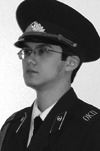
For example, early images from the 1970s and early 1980s portray them in the a variety of army dress uniforms--the regular male members wear everyday uniforms, though curiously, female members seem to wear dress uniforms, as does the conductor (this could be easily explained by assuming that all members are wearing parade uniforms, and all female members are officers, as is the conductor, a lieutenant colonel, while male members are enlisted men or NCOs).
I recall a clip of the Red Army Choir singing 'The Battle Hymn of the Republic' before Billy Graham, during his visit to the country in the 1980s. It was part of his documentary--I don't particularly like the man, and I was rather annoyed when the narrator and Graham's associates made it sound as though it was his doing that they were singing thanks to him, not because of Gorbachev or anyone else. :mad:
I mention this because at that point, and during the infamous 'Total Balalaika Show' in 1993, the Red Army Choir wore Honor Guard Uniforms--all the members had the the gold-lined shoulder boards and sunburst-insignia on their caps (with the exception of the conductor, who wore no cap and a sunburst badge on the breast of his uniform). I remember the site 'Under the Red Star' makes some mention of a brief transition for musical orchestras towards wearing Honor Guard uniforms in the late 1980s--so that makes sense. The Red Army Choir also has the Honor Guard sleeve patches.
What happens next, in the 1994 Nokia Balalaika Show (in Berlin) is interesting. Less than a year later, and none of the choir members have changed (to my knowledge), all of them are sporting transitional army caps, as described at Under the Red Star, at the end of the army caps section. They have lyres pinned to the crowns, and are still sporting a Soviet badge cap--they have lost the Honor Guard sunbursts. The uniforms themselves look like contemporary Russian ones, with breast pockets and Russian sleeve patches.
As of the recent years, the transition has been entirely complete, and by the time of the 'Global Balalaika Show' in 2003 (which borders are the totally bizarre, even for me), members have Czarist Eagles on their cap crown's and Russian sleeve patches.
So...what to make of this? The Red Army Choir transitions faster/slower than the formal Russian army in terms of uniform changes....who knows? In any case, it's something I noticed, and there aren't enough topics about this fantastic musical group I think.
Synthesis Wrote:For example, early images from the 1970s and early 1980s portray them in the a variety of army dress uniforms--the regular male members wear everyday uniforms, though curiously, female members seem to wear dress uniforms, as does the conductor (this could be easily explained by assuming that all members are wearing parade uniforms, and all female members are officers, as is the conductor, a lieutenant colonel, while male members are enlisted men or NCOs).
From what I remember, members of performing groups such as the Red Star Red Army Chorus were contract workers of the Ministry of Defense -- subject to military regulations, but not exactly the same status as officers and conscripts.
In contrast to war-time necessity, peacetime military service was not considered a normal woman's occupation, so women in uniform were somewhat unusual. And probably out of aesthetics, a normal conscript-cut uniform was probably considered not as flattering to a woman's proportions. The 1989 uniform regulations show enlisted women wearing officer cut uniforms with officer's cap badges, along with shoulderboards and arm patches indicating enlisted rank. Since an enlisted woman would be a volunteer, I suspect they had similar uniform prerogatives as extended-service soldiers, i.e. officer-style uniforms.
Synthesis Wrote:I mention this because at that point, and during the infamous 'Total Balalaika Show' in 1993, the Red Army Choir wore Honor Guard Uniforms--all the members had the the gold-lined shoulder boards and sunburst-insignia on their caps (with the exception of the conductor, who wore no cap and a sunburst badge on the breast of his uniform). I remember the site 'Under the Red Star' makes some mention of a brief transition for musical orchestras towards wearing Honor Guard uniforms in the late 1980s--so that makes sense. The Red Army Choir also has the Honor Guard sleeve patches.
What happens next, in the 1994 Nokia Balalaika Show (in Berlin) is interesting. Less than a year later, and none of the choir members have changed (to my knowledge), all of them are sporting transitional army caps, as described at Under the Red Star, at the end of the army caps section. They have lyres pinned to the crowns, and are still sporting a Soviet badge cap--they have lost the Honor Guard sunbursts. The uniforms themselves look like contemporary Russian ones, with breast pockets and Russian sleeve patches.
I wonder if the sunburst vs. lyre badge has anything to do with the venue. The sunburst badge indicated assignment to an honor guard in a capital or hero city. If they were performing outside the country, the lyre would have been worn(?)
Synthesis Wrote:As of the recent years, the transition has been entirely complete, and by the time of the 'Global Balalaika Show' in 2003 (which borders are the totally bizarre, even for me), members have Czarist Eagles on their cap crown's and Russian sleeve patches.
So...what to make of this? The Red Army Choir transitions faster/slower than the formal Russian army in terms of uniform changes....who knows? In any case, it's something I noticed, and there aren't enough topics about this fantastic musical group I think.
It makes sense that a small, showpiece assembly would much more easily and quickly be outfitted with the latest uniform evolution than the rest of the standing army.
Also, mixed uniforms may be as a result of expediency required between amount of props you can transport vice the desire to create an effect such as the tsarist/Russian mix you mention.
The troup does historical renditions and I'm sure it's easier to throw on an outdated tsarist cap on the base uniform to create a "pre-revolutionary" image then transfer (and change into) a historically accurate 1910-era cossack cavalryman, for example.
03-21-2007, 01:34 PM (This post was last modified: 03-21-2007, 01:38 PM by Synthesis.)
ibaya Wrote:I wonder if the sunburst vs. lyre badge has anything to do with the venue. The sunburst badge indicated assignment to an honor guard in a capital or hero city. If they were performing outside the country, the lyre would have been worn(?).
Interesting theory...though you have to remember, the 'Total Balalaika Show' was set in Helsinki--indeed, the show was performed right next to the Finnish Parliament Building.
In retrospect, I think the Red Army Choir was always considered the "equivalent" of an honor guard company, in some degree--the photographs from the 1970s/early 1980s simply predate the usage of sunburst badges on honor guard units (uniforms still have alguilettes and enlisted caps still have golden cords). Perhaps the honor guard status had been revoked by 1994--or it might have had to do with the fact that, in 1994, their performance was in celebration of the final units of the Allied occupation leaving Berlin?
As for the female members of the ensemble (who primarily make up the dancing portion, as it is an all-male choir), you rarely see them in uniform anyway--they, along with their male counterparts in the dance ensemble, wear traditional Russian attire of a various types (during the Total Balalaika Show, Cossack's Dancing attire seemed very common, I think).
I remember in fall of 2002 or 2003 they came a performed at my college and when they did some song about the sea they wear the striped shirt and sailors hat with soviet insiginia. Yes they did have the cossack clothing during some of the sons. What I do remember was they came out in their army uniforms at the end and did a meet and greet, What was intresting was that them members had different buttons on their uniforms. One had the soviet era hammer and sickle buttons and another had the tsarists era eagle buttons that is now used in russia.
The first photo shown at the beginning of the thread (posted by Synthesis) depicts the organization as it was in the DVD "Red Star" of which I own a copy. I also had some concern about the differences in the uniforms worn by male personnel, female personnel, and the conductor. Recently, I obtained a book covering the uniforms from 1917 to the present and, lo and behold, the uniforms in that picture and the DVD were worn concurrently just prior to the break-up of the Soviet Union. I do, however, think it "weird" that uniforms between the officer and enlisted ranks, as well as those between male and female personnel, differ so much in other countries; but I've been around fairly extensively both as a civilian and as a sailor and I know a lot of countries follow this practice.
"We are Marching for the Victory of Communist Labour" V.I. Ulyanov (Lenin)
Greg Collins Wrote:The first photo shown at the beginning of the thread (posted by Synthesis) depicts the organization as it was in the DVD "Red Star" of which I own a copy. I also had some concern about the differences in the uniforms worn by male personnel, female personnel, and the conductor. Recently, I obtained a book covering the uniforms from 1917 to the present and, lo and behold, the uniforms in that picture and the DVD were worn concurrently just prior to the break-up of the Soviet Union. I do, however, think it "weird" that uniforms between the officer and enlisted ranks, as well as those between male and female personnel, differ so much in other countries; but I've been around fairly extensively both as a civilian and as a sailor and I know a lot of countries follow this practice.
I don't completely follow you, but...
In the 'Global Balalaika Show' (again, weird beyond weird), the chorus is made up of both men and women in parade uniform...and here's where it gets strange.
As you can see in the picture, the men in the chorus where the brown uniform we're all quite familiar with...however, the women's parade uniforms are white, and lack normal ties (instead using the--if you'll let me say--ugly ribbons worn by western female dress uniforms), and what look like pilotka caps. The choice in color is really bizarre...I'm tempted to say that they're wearing navy uniforms from the color schemes, however, navy uniforms don't change a great deal over time (so they'd at least look similar to their Soviet equivalents, which they don't).
It could just be that women's parade uniforms are a different colors from men's (bleached white versus sea-wave green). This is a pretty sharp departure from the Soviet regulations, which had all enlisted men/women wearing the same color (and the same uniform practically, barring a different hat, skirt, and slightly longer tunic for women), and all COs wearing the same sea-wave green.
It may be just an attempt to make the uniforms look more western--with distinctions between men and women (apparently, a women's dress uniform with a tie is just too Soviet). Kind of sad, I suppose.
On a side note...note that in the first picture (and indeed, all of them), all the members of the orchestra where normal walking shoes, rather than boots, regardless of gender. I'm not sure exactly what were the regulations for parade-uniforms with normal shoes (walking out? Maybe not...), or perhaps it might just be in the interests of comfort.
Synthesis Wrote:On a side note...note that in the first picture (and indeed, all of them), all the members of the orchestra where normal walking shoes, rather than boots, regardless of gender. I'm not sure exactly what were the regulations for parade-uniforms with normal shoes (walking out? Maybe not...), or perhaps it might just be in the interests of comfort.
Synthesis,
That one is pretty simple to answer:
. Straight pants = shoes
. Golf pants = boots
What I have found is that the more formal the occasion, the more you want to wear straight pants. Riding breeches and boots may look great on parade, but are generally considered a bit "crass" at a more elegant function. A US example of this is that airborne troops will generally wear cap-toed jump boots with their pants bloused over the top- with all uniforms except when attending a more upscale function. Then the shiny low-quartered oxford is considered more appropriate.
"We are Marching for the Victory of Communist Labour" V.I. Ulyanov (Lenin)