

His Story Collections Presents
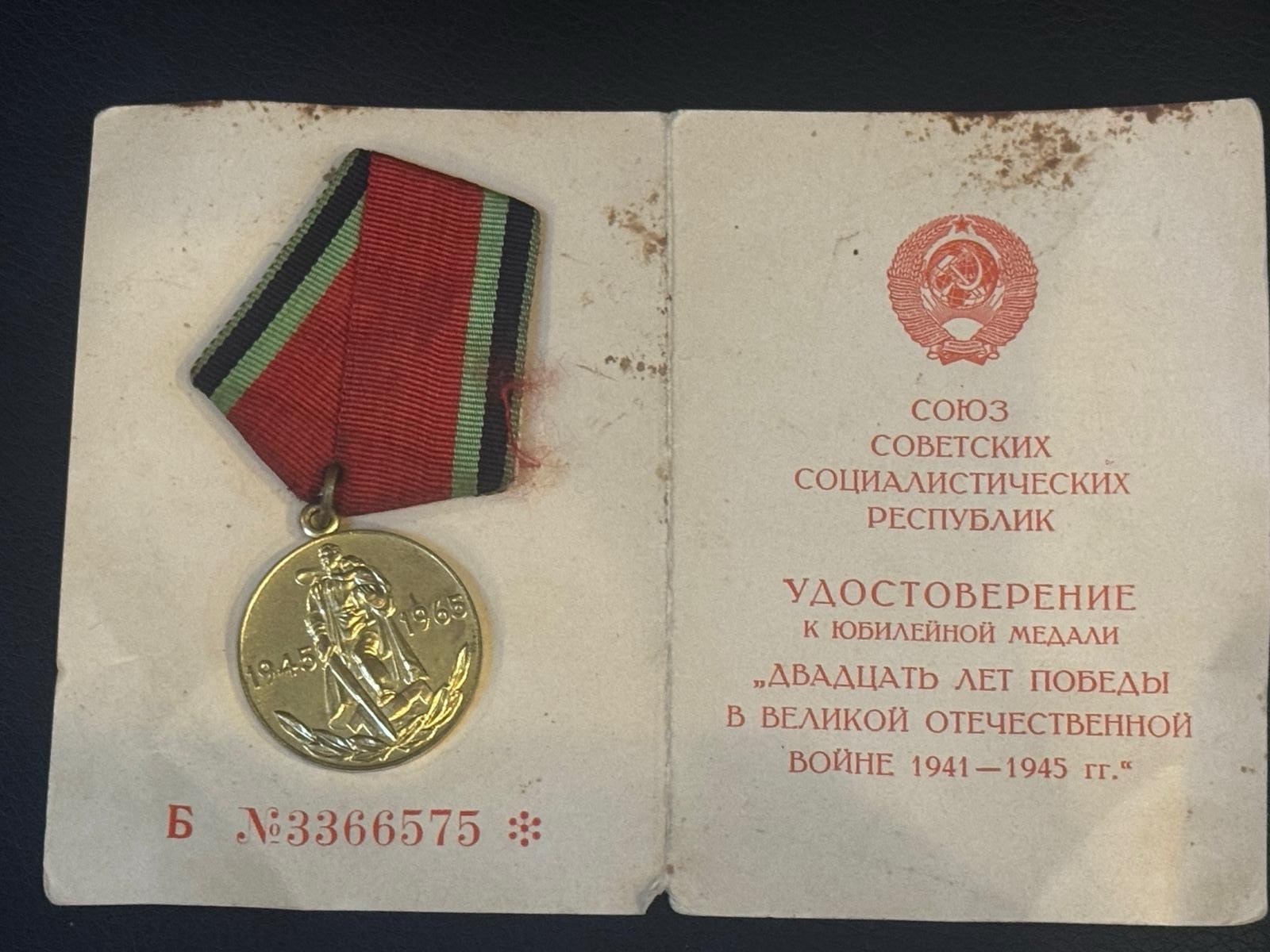
1965 Soviet WWII 20th Anniversary Victory Medal
“Twenty Years of Victory in the Great Patriotic War 1941–1945”
Original Named Award Certificate • Medal & Document Set
⸻
The Story — Twenty Years After Victory
In 1965, two decades had passed since the end of the war that the Soviet Union remembered as the Great Patriotic War.
The human cost had been immense. Cities had been destroyed, families divided, and millions of soldiers and civilians had been lost. By the mid-1960s, victory in 1945 had become one of the central pillars of Soviet public memory.
To mark the twentieth anniversary, the Soviet government issued a special jubilee medal:
“Twenty Years of Victory in the Great Patriotic War 1941–1945”
This example is especially appealing because it survives together with its original named award certificate, preserving not just the medal itself, but the official documentary context in which it was issued.
⸻
The Medal
The obverse bears the dates:
1945 – 1965
At the center is the famous Soviet soldier figure associated with the Treptower Park Soviet War Memorial in Berlin.
The monument depicts a Soviet soldier carrying a rescued child while standing over a broken swastika, a powerful postwar image used to symbolize victory over Nazi Germany and the protection of civilians.
The design became one of the most recognizable visual representations of Soviet victory.
Around the lower edge of the medal is a laurel motif, reinforcing the traditional symbolism of military triumph and remembrance.
⸻
The Reverse — XX Years
The reverse is dominated by the large Roman numeral:
XX
representing twenty years.
Around it appears the Russian inscription commemorating:
Twenty Years of Victory in the Great Patriotic War 1941–1945
The design is simple, direct, and unmistakably commemorative.
This was not a campaign medal awarded during the war itself, but a later state decoration intended to recognize those who had lived through and contributed to the victory being commemorated.
⸻
The Ribbon
The medal hangs from its original-style pentagonal Soviet suspension.
The ribbon features a broad red field with narrow green and black stripes at the edges.
The ribbon on this example shows visible age-related wear and fraying, especially along the edge.
For a historical collectible, this is part of the object’s life and should be preserved rather than restored.
⸻
The Original Award Certificate
The strongest feature of this set is the accompanying Soviet award booklet.
The cover bears the state emblem of the USSR and the official title of the medal.
Inside, the certificate records the recipient by hand and includes an official stamp and signature.
The document is dated:
7 May 1965
This is highly appropriate to the medal’s historical context, as the twentieth anniversary commemorations centered on Victory Day in May 1965.
The booklet also carries serial/reference number:
Б №3366575
The survival of the original named certificate significantly improves the historical integrity of the set.
A loose jubilee medal can tell us what type of award it was.
A medal with its certificate reminds us that it was once issued to a specific person.
⸻
From Mass Award to Personal History
This medal was issued on a large scale, which means loose examples are not especially scarce.
But that does not make the history ordinary.
Each one belonged to an individual life.
The accompanying certificate turns this example from an anonymous medal into a surviving personal record from the Soviet commemoration of World War II.
The recipient’s name, the official stamp, the date, the aged paper, and the ribbon all contribute to the sense that this object passed through a real bureaucratic and personal moment in 1965.
⸻
The Great Patriotic War in Soviet Memory
The phrase “Great Patriotic War” refers specifically to the Soviet struggle against Nazi Germany and its allies from 1941 to 1945.
By 1965, the war had become more than recent history.
It had become part of Soviet identity.
Victory anniversaries increasingly became major public events, accompanied by parades, ceremonies, memorial construction, veteran recognition, and commemorative medals.
This medal belongs to that moment when wartime memory was becoming formalized into a national commemorative tradition.
⸻
Treptower Park and the Soldier with the Child
The image on the medal is especially powerful because of its connection to the Soviet War Memorial at Treptower Park in Berlin.
The monumental sculpture depicts a Soviet soldier holding a small child while carrying a sword.
The broken swastika beneath him represents the defeat of Nazi Germany.
Whether viewed as memorial art, state symbolism, or Cold War-era visual culture, the image became deeply embedded in Soviet remembrance of the war.
By placing this figure on the 1965 jubilee medal, the state linked individual veterans and recipients directly to the broader national story of victory.
⸻
A Documented 1965 Set
This example includes:
1965 Jubilee Victory Medal
Original ribbon and suspension
Original named Soviet award certificate
Official stamp and signature
1965 issue date
Certificate number Б №3366575
Together, these elements make the group more desirable than an anonymous loose medal.
⸻
Condition
The medal retains strong gilt-toned surfaces with visible age-related handling and minor wear.
The ribbon shows fraying and wear, particularly at the edge.
The certificate has age-related toning, marks, folding, staining, and handling wear consistent with a document approximately six decades old.
These signs of age are visible in the photographs and form part of the historical character of the set.
Please review all photographs carefully.
⸻
Historical Collectible Notice
This item is offered solely as a historical, educational, and collectible artifact.
The preservation and sale of Soviet military and political memorabilia does not constitute endorsement of any government, ideology, military action, or historical system.
⸻
A Piece of History You Can Hold
The war ended in 1945.
Twenty years later, the Soviet state called its veterans and wartime generation back into public memory.
This medal was part of that act of remembrance.
Today, the most important part of this example may not be the medal itself.
It is the fact that the document survived beside it.
A name.
A date.
A stamp.
A ribbon.
A small official record connecting one individual to the enormous history of the Second World War.
His Story Collections — preserving the objects through which history was lived.
